
A former courtroom artist brings art to his neighbors at Brightview Senior Living
By Shane Gomez
From the Central Park Five to the man who killed John Lennon, Robert Smith has sketched some of the most well-known court cases of the 1980s and 90s.
Now, Smith, age 80 and a resident of Brightview Senior Living Woodburn in Annandale, still does what he loves. He sketches entertainers who perform at the assisted-living facility and leads art classes for residents.
[Brightview Senior Living Woodburn is a sponsor of the 2025 Taste of Annandale.]
A career in court
Smith worked as a courtroom sketch artist, primarily in New York City, from 1980 to 1993, during trial proceedings when the use of cameras was prohibited. Courtroom artists work for a news organization; Smith worked for CNN, WPIX-TV, Thirteen, and others.
“A courtroom artist tells a story about what happened in a courtroom,” Smith says.
Sketch artists must capture the 12 jurors, the defendant, spectators, and the judge, accurately depicting faces, postures, movements, and the mood of the room, he says. They usually complete two or three drawings by the end of the day.
Artists draw as the trial proceeds, he explains. Proceedings are unpredictable in length and action, so sketches must sometimes be made in minutes. Then, the artist rushes to deliver the sketches to the news organization in time for broadcast deadlines.
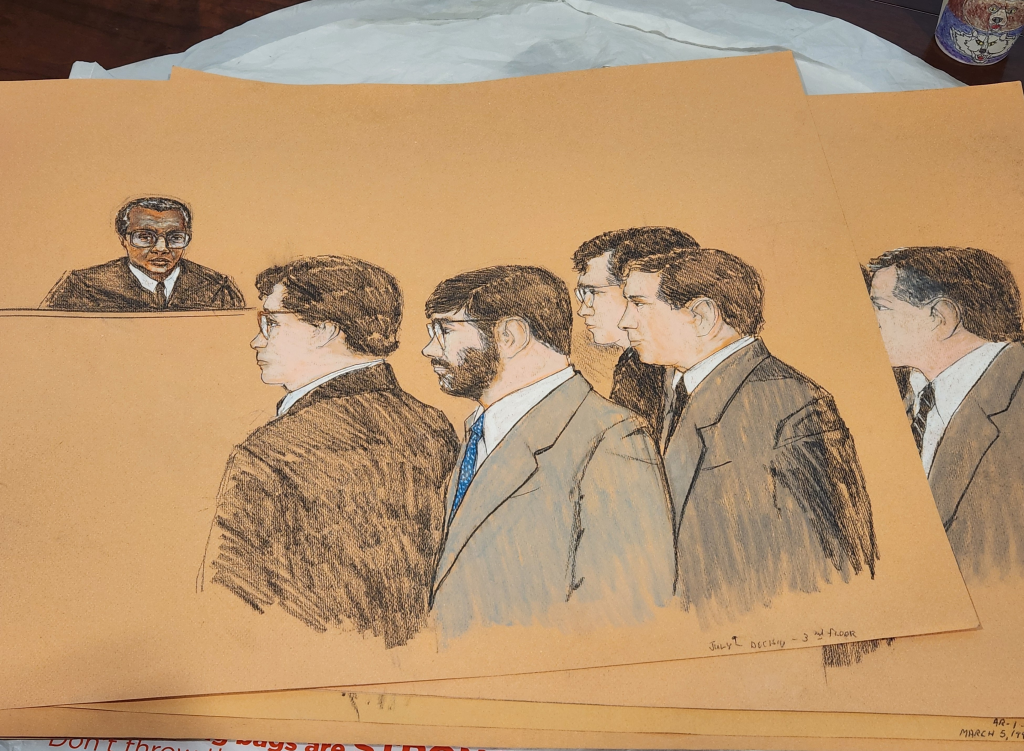
Among the high-profile cases Smith covered during his 13-year career are Jean Harris, the diet doctor killer; subway vigilante Bernhard Goetz; the Brinks Robbery, the Baby “M” contested surrogacy case; Filipino politician Imelda Marcos; and Ariel Sharon’s war crimes trial.
“Each case takes on a different personality,” he says.
When John Lennon was shot and killed in 1980, Smith was called early in the morning by CNN to go to the courthouse and sketch a portrait of the accused killer, Mark David Chapman. At that point, no one knew what he looked like, he recalls.
Smith waited for six hours until Chapman arrived at 9 a.m. Chapman was only in court for ten minutes, but Smith managed to get the sketch.
Days later, Smith visited a makeshift memorial for John Lennon at Strawberry Fields in Central Park. “It was just my way of releasing all the feelings that I had having to draw the killer of John Lennon.”
In time, cameras began to replace courtroom artists, he says. Camera technology became more inconspicuous, demand for visuals increased, and judges started allowing them. He was featured in a 1981 New York Times article headlined “Camera’s return may eclipse jobs of court artists.”
“An artist is kind of a luxury,” Smith says. “I found it harder and harder to make a living with more and more cameras being allowed in.”
Eventually, he moved on to other pursuits, including leading activities at Liberty Science Center in Jersey City.
A young artist
Smith grew up in Madison, N.J. In 1975, he moved to Manhattan, where he lived for 40 years.
“I’ve just always enjoyed drawing people,” he says. As a teenager, he would place a grid on the television screen and sketch characters, like Superman.
He attended art school in Philadelphia and “found that I had a facility for drawing figures.” In college, he did not intend to become a courtroom artist, although as a junior, he took a sketch class held in a courtroom.
Years later, while working as an illustrator in New York City, Smith saw work by courtroom artists on television. He wondered if it was something he could do. So, he contacted the broadcast channel, was told to build a portfolio, and started practicing at night court. Then, he got the job.
“The high point of being a courtroom artist is the fact that you can bring your work to people, to spectators, to show them what happened in the courtroom that day,” Smith says. “I guess that’s the greatest feeling I have.”
A new home
Smith moved to Brightview Senior Living on Gallows Road nearly two years ago.
His favorite thing to do here? “It’s all in that sketchbook,” says Smith, pointing to a thick notebook. “My favorite thing is drawing.”
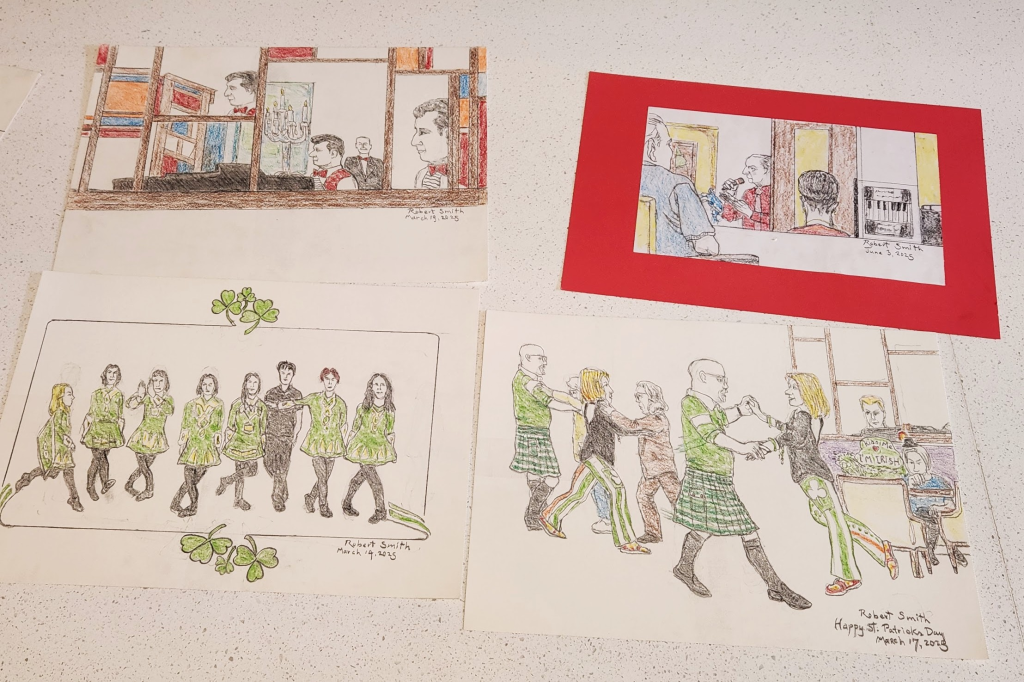
Smith likes to sketch the entertainers that visit – Irish dancers, Chinese New Year performers, an Elvis impersonator, among others. Thanks to an arrangement through Lisa Semonick, vibrant living director at Brightview Woodburn, the sketches are given to the entertainers.
Sometimes Smith sketches residents – he sketched the poker group, with each player depicted as a different card – but he is sensitive to who may not want to be drawn.
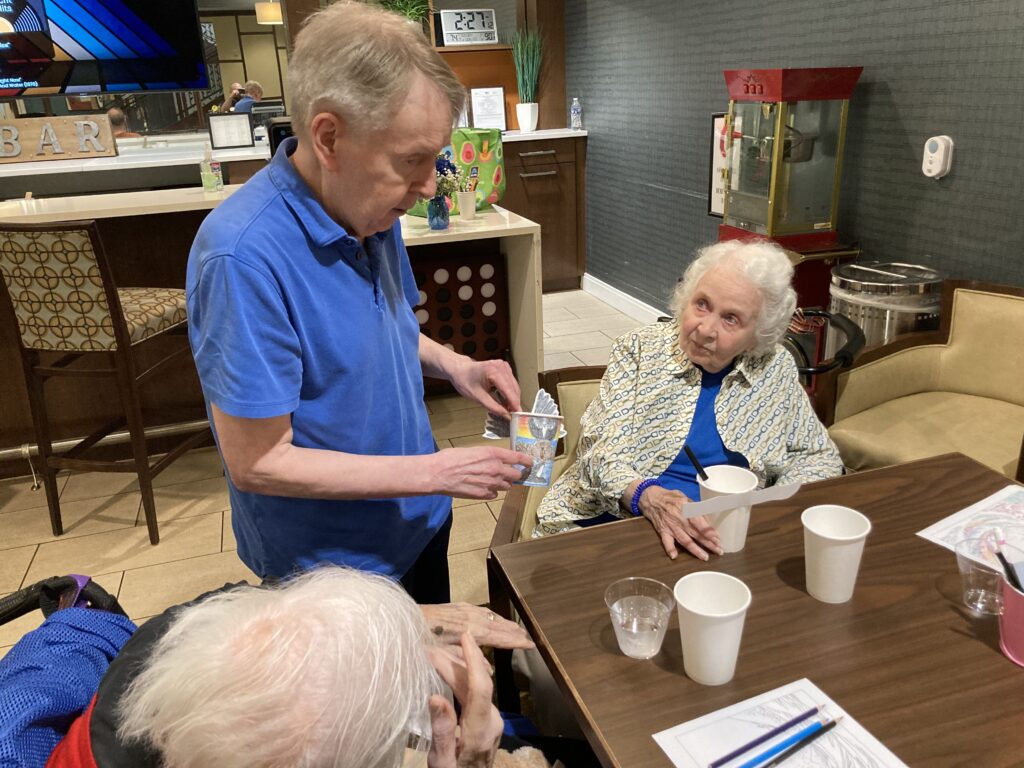
Smith also occasionally leads art classes at Brightview. For one activity, where residents decorated coffee cups in the style of totem poles, Smith sketched outlines for residents to color in and apply to the cups.
“I’ve been pleasantly surprised,” Smith says. “Having a support group, with Lisa, has helped me, and I found many other residents and employees here very responsive to it. So, it’s very encouraging.”
Smith and Semonick plan to take the totem pole cup activity to a nearby library, since it’s a good activity for children, as well as seniors.
“I’ve always enjoyed giving back,” Smith says.
Shane Gomez is Annandale Today’s summer intern.
Wonderful story!