
An interpretive sign honors a Black community displaced by eminent domain
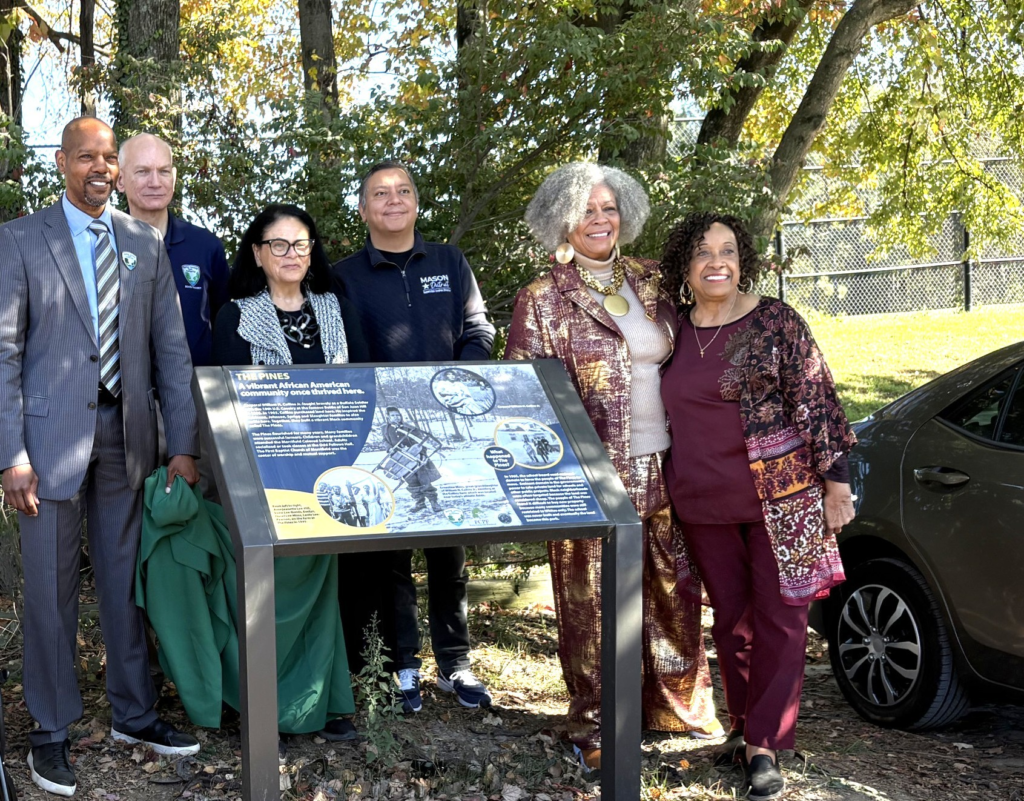
A few decades ago, there was a thriving close-knit Black community called The Pines in what is now Pine Ridge Park on Woodburn Road in Annandale.
It was a place where everyone was related or knew one another, where children played outdoors all day, built forts, and picked blackberries and cherries.
It’s also the site of one of the most shameful episodes in Fairfax County history. In 1965, the county took residents’ property by eminent domain to build a school. The school was never built.
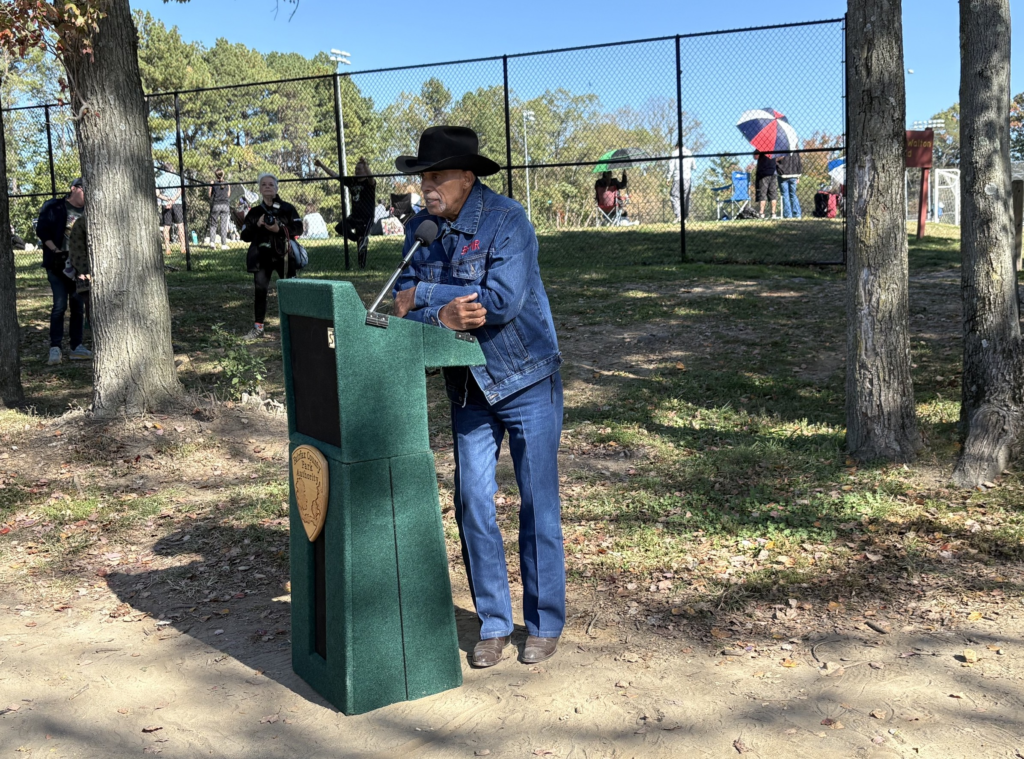
On Oct. 25, former residents of The Pines and descendants of the families who lived there gathered for a ceremony to unveil an interpretative sign recognizing a community that now only exists in people’s hearts and memories.
“Like most African American communities and traditions, our history will never be washed, wasted, denied, or forgotten,” said Rev. Paul Sheppard of the First Baptist Church of Merrifield, where many residents of The Pines worshipped, and their descendants still maintain ties.
“We must teach our children that their heritage and history are worthy of dignity and respect,” Sheppard said.
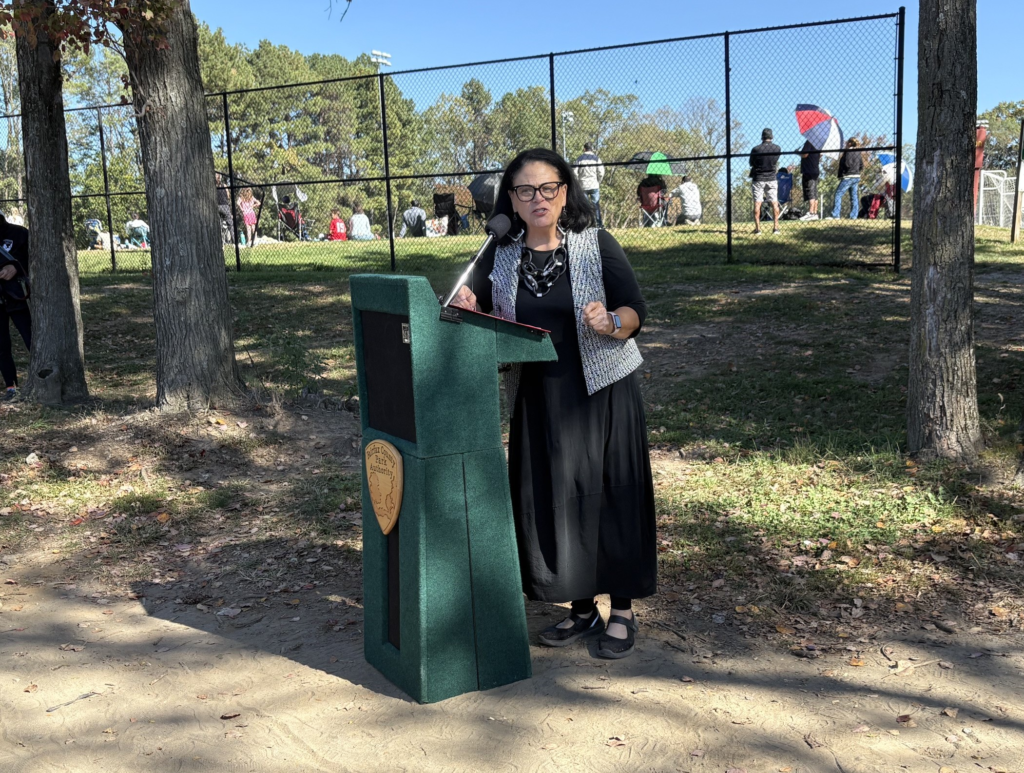
“It’s our responsibility to tell the whole story, not just the facts that make us comfortable,” said Nigel Fields, the Park Authority’s deputy director for planning and development.
“The new interpretive sign is not just a marker. It is more than just a reminder,” Fields said. “It is a mirror reflecting a story that was once overlooked, that is now being elevated.”
The first settler in The Pines was William Collins Jr., a Buffalo Soldier who fought in the Spanish American War alongside Theodore Roosevelt in the Battle of San Juan Hill, said Marian Ransell Dobbins, one of his direct descendants and the author of The Lost Black Communities of Merrifield, The Pines and Williamstown.
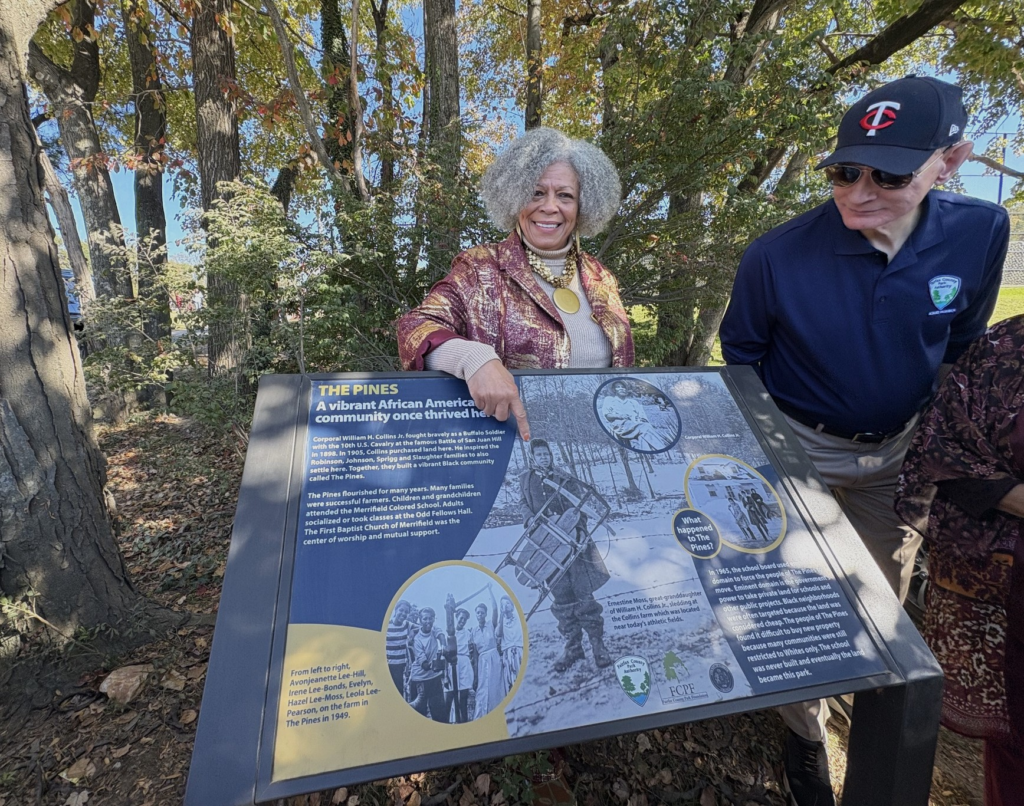
In 1905, Collins purchased 20 acres, raised his family there, farmed the land, and sold portions to other African Americans, who established the community called The Pines. Collins and members of his family are buried in the Liberty cemetery at the edge of Pine Ridge Park, the only remaining vestige of The Pines.
Dobbins’s grandmother, Myra, and Myra’s siblings inherited the land from Collins. It was a community where children were taught the “life lessons of compassion, love of family, hard work, and godliness,” she said.
Related story: Historic marker commemorates a vanished black community
“Today, we honor responsible Black citizens, like my grandmother, who paid their taxes, bills, and a poll tax so they could vote,” Dobbins said. “They purchased land and cars, created a place filled with love, spirituality, laughter. And most of all, a lot of music.”
Her uncle Guy Collins had a house that looked like the White House, where the Pine Ridge garden plots are now. The house had a music room with a full-size harp and a Steinway piano, where Uncle Guy, a master musician, composed cantatas and gave music lessons to the children of The Pines.
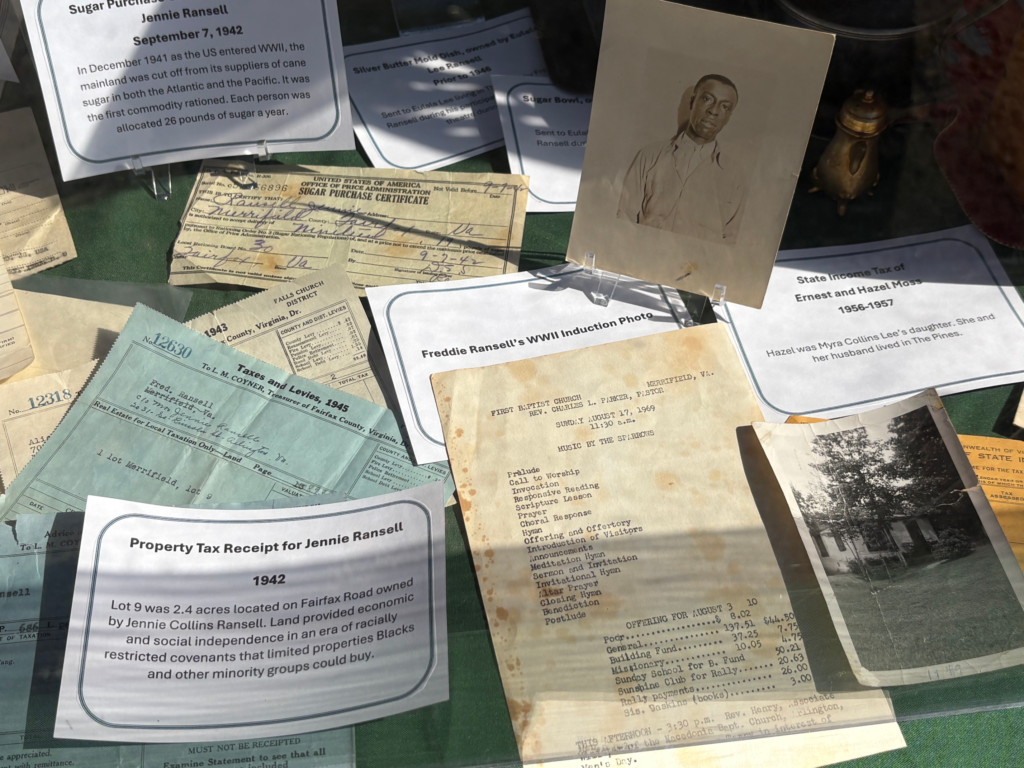
Ronnie Marshall, who grew up in The Pines, said he was born at home because Blacks weren’t allowed to be born in hospitals in Virginia at that time, and his parents couldn’t find a car to get to D.C. fast enough.
He recalls playing in the creek and more often than not falling in, walking along Gallows Road, which was too narrow to let two cars pass at the same time, and watching the horses at a nearby farm. His love of horses eventually led to a career as a rodeo competitor.
“When hard times came, we came to the aid of one another,” Marshall said. No one went hungry, because families shared what they had. Kids couldn’t get away with too much, because a neighbor would call their parents if they saw anything suspicious.
Everything that made The Pines a special place was taken away in 1965 when the all-White Fairfax County board decided to take people’s properties through eminent domain, Dobbins said. Her grandmother was offered just $16,000 for her home, but couldn’t afford to buy anything in the county, and even if she could, banks wouldn’t approve home loans for Blacks.
“My grandmother lived every day after 1965 in pain, losing what she loved, the land that she got from her father, the land that she was raised on, the land that she raised her children on, the land that her grandchildren, like me and many others, played on. It was gone,” Dobbins said.
“But finally, now, we can stand up, and we can say what happened to the people in The Pines,” she said. “We’re still here. And we’re strong.”
“Our community may be gone, but we are not,” Dobbins said. “And we stand together, here today, to honor those who left us.”
The land should have been returned to those it was taken from. Shame on Fairfax County.
I’m glad to see the history of this spot acknowledged in this way.
Quibble: “Blacks” is not the best wording. Perhaps “Black people” instead?
This was not “a few decades ago”: 62 years ago is more than a decade past a half-century. The article makes it sounds like maybe this all happened in the 2000s, which was a “few” (meaning about 3) decades ago. This gratuitous exaggeration does not help tell the true story.
Most or all of the County officials that made this decision have been dead for more years (probably a few decades) longer than the reporter has been alive. The great-grandchildren of the residents of The Pines should understand that math, too.
Question: What other properties did Fairfax County take since say 1960, and who lived there?
That’s not the point. Two (or more) wrongs do not make one right. Quaint, but effective.
Can you supply any explanation that supports your claim of this story being a “gratuitous exaggeration”?
Or perhaps share what you understand is the “true” story?
Nonetheless, this is a story that deserves to be told no matter how old the subject. What the county did was a callous act with no doubt, racial overtones.
Where are the reparations due to the descendants whose land and community was grabbed against the false pretenses of building a school? This ‘eminent domain’ has also happened to black communities in Alexandria where the ACHS (formerly TC Williams high school) is located and also land near Fort Ward which belonged to African Americans. A plaque is more than nothing and a long time coming, but seems too little too late and quite minimalistic in the scheme of things for Fairfax County.
This is not the only park where the Fairfax County Park Authority took this action.
Glad Fairfax County and the Park Authority are now using eminent domain in a better way.
Why is it that a sign is always the settlement for destroying black communities? It commemorates the cruel sins whose pain and suffering still linger. While others get reparations in more meaningful ways, for us years of wrong-doing only gets a commemorative sign documenting or better stated commemorating what some may consider the successful destruction of generational wealth and achievement of our black communities. Rebuilding these communities and making former landowners whole and adding that achievement to the facts of the sign may serve to be a better commemoration with commensurate deterrence, respect and reparations.
Hey look, Speedy Jimenez at a photo op.
THANK YOU for telling the story.
THANK YOU for the sign commemorating and or righting a wrong done to Fairfax County citizens.
THANK YOU, Fairfax County Board of Supervisors, for further righting a wrong through the allocation of reparations to The Pines descendants.