
Early voting starts tomorrow on redistricting
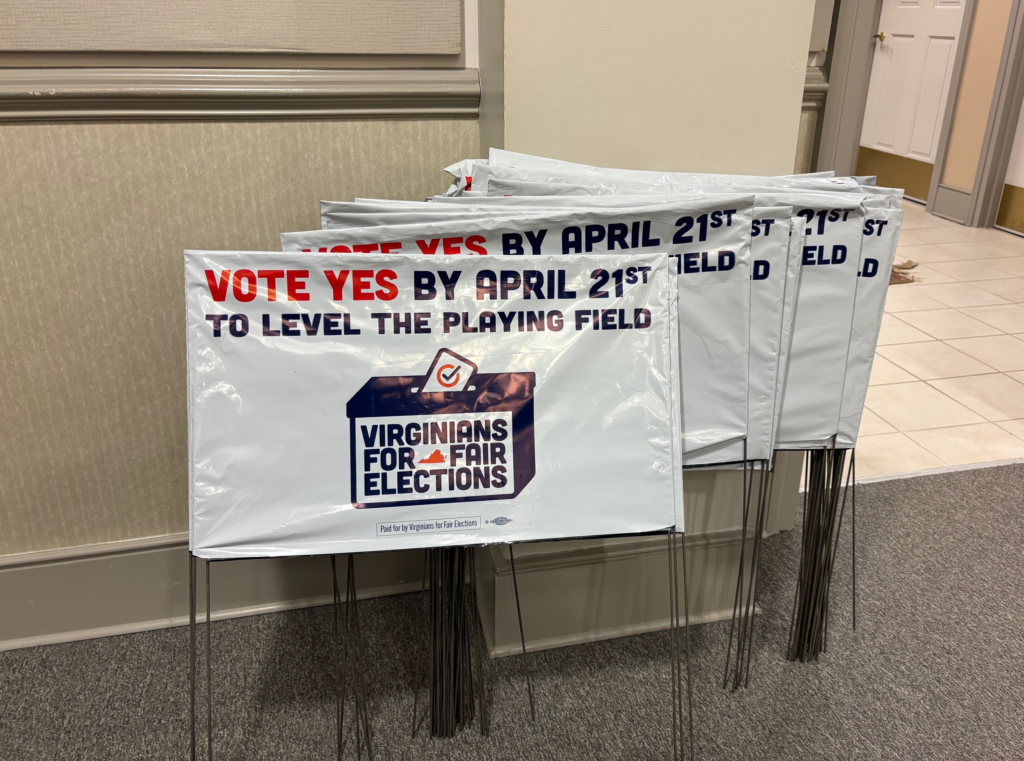
Early voting starts tomorrow, March 6, on a state constitutional amendment authorizing a redistricting plan for members of the House of Representatives.
The measure is designed to level the playing field to give Virginia Democrats an edge following redistricting actions by other states that benefit Republicans in the 2026 midterm elections.
Virginia’s redistricting plan only affects congressional districts; it wouldn’t change the General Assembly districts. It’s a temporary measure that expires after the 2030 Census.
Restoring fairness
The special election will take place on April 21. Between March 6 and April 18, early voting will be conducted at the Fairfax County Government Center, the Mount Vernon Government Center, and the North County Government Center.
Early in-person voting opens at other locations April 11-18, including the Mason District Government Center and the Thomas Jefferson Library.
The deadline to apply for an absentee by-mail ballot is April 10. The deadline to register to vote is April 14.
Related story: Virginia Supreme Court approves referendum on redistricting
This is the ballot question: “Should the Constitution of Virginia be amended to allow the General Assembly to temporarily adopt new congressional districts to restore fairness in the upcoming elections, while ensuring Virginia’s standard process resumes for all future redistricting after the 2030 Census?”
The Virginia Supreme Court last month rejected legal challenges filed by Republicans and ruled that the referendum can go forward.
The Virginia referendum is needed “because MAGA-led states, at the direction of Trump, are manufacturing their own mega-majorities behind closed doors,” said Jackson Miller, field director for Virginians for Fair Elections. “They will do anything to hold on to power.”
Republicans hold a slim majority in the House, with 218 members, compared to 214 Democrats.
Unlike the Republican states, Virginia’s redistricting plan will be determined by voters. And it can’t take effect unless another state acts first, which has already happened.
Leveling the playing field
A redrawn map in Texas could add five Republican seats in the midterms. That effort was countered by California, which approved a redistricting plan that could add five Democratic seats. Redistricting actions in North Carolina, Ohio, and Missouri also favor Republicans, while a redrawn map under consideration in Florida could add up to four GOP seats.
“What started in Texas, we’re going to finish right here in Virginia,” Miller said at a community meeting on March 2 in Fairfax.
Miller expects the Republicans to take more legal action against the redistricting referendum because “that is the bedrock of their strategy.” He called the lawsuits “a way for our Republican opposition to sow confusion, anxiety, and mistrust.”
Restoring a Democratic majority in the House of Representatives is critical because Congress has ceded power to Trump, who is using the government like his own personal bank,” said Manisha Singh, chair of Virginia’s 11th Congressional District Democratic Committee. “We need oversight. We need accountability.”
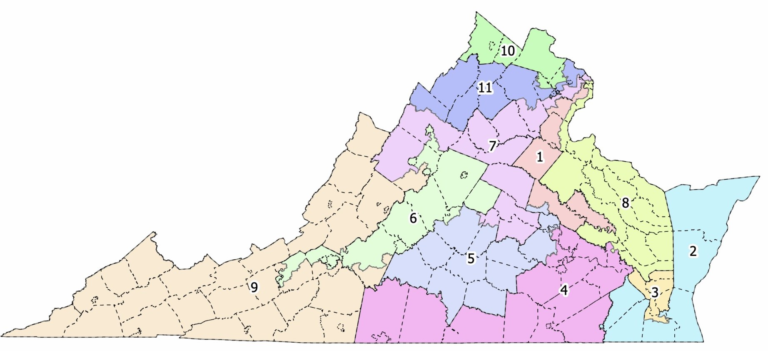
Redistricting will be challenging for the Northern Virginia delegation, Singh acknowledged. For example, the 11th District seat, held by Rep. James Walkinshaw, would be extended all the way to the West Virginia border.
Rep. Don Beyer would have to campaign in Norfolk and Virginia Beach, due to the new outline of the 8th District.
New districts
Fairfax County is currently split among three congressional districts. Under the redistricting plan, there would be five: the 10th, 11th, 7th, 1st, and 8th districts. Look up your new district here.
School board member Kyle McDaniel (at-large) said a Democratic majority in the House is critical for Fairfax County schools.
Appropriations and tax bills originate in the House, and those bills include funding for school meals, English language learners, and special education, McDaniel said. Meanwhile, the Republicans in the House are going along with Trump’s effort to dismantle the Department of Education.
Miller noted that he is personally affected, like so many others, by the Republican majority in the House. Thanks to gerrymandering in North Carolina, he said, the “big ugly bill passed, and my healthcare premiums have quintupled.”
Laura Stokes, chair of the Fairfax City Democrats, said it’s important to spread the word about the upcoming referendum, as the special election will not have anything else on the ballot.
She urged community members to persuade their friends and family to vote for the referendum, write postcards, make calls, and canvass door-to-door. “The Republicans are not campaigning,” she said. “They’re trying to game the system by going through the courts.”
Well, guess this publication puts editorials in “news” stories?
The extensive quotations of Democratic leaders disparaging resort to court proceedings are symptomatic of the distressing trend of undermining respect for courts and the rule of law. The statement that the Virginia Supreme Court approved the referendum is not correct. Here is what has happened. The Virginia Supreme Court reversed a lower court injunction that barred a locality within that court’s jurisdiction from taking measures to hold the vote. Sadly we see court shopping at both the state and federal level in which a lower court with limited geographic jurisdiction issues an order that purports to have statewide or nationwide effect. It has become a political gambit that operatives of both parties use to promote their partisan narratives. It is settled law that 1) courts should not issue injunctions unless there would be irreparable harm; 2) election laws are political questions so courts should be reluctant to intervene; and 3) courts should only decide cases that are “ripe” for review. The court in this case lifted the injunction and set a briefing schedule to hear legal arguments that would not permit an opinion to be rendered until after the date set for the election. If the referendum is defeated, the case is moot and can be dismissed. If it passes, then the Court can review the legal claims and decide after careful deliberation. This is how courts are supposed to function. As an attorney I find press reports of court proceedings and opinions are almost invariably presented with a partisan political spin that is inaccurate and sometimes intentionally inflammatory. There is no understanding or appreciation for the legal reasoning, just quotations from those who see political advantage from inflamming passions. This unfairly discredits the judiciary and undermines respect for the rule of law and that has motivated my comment.