
Residents urge Virginia to impose a data center moratorium
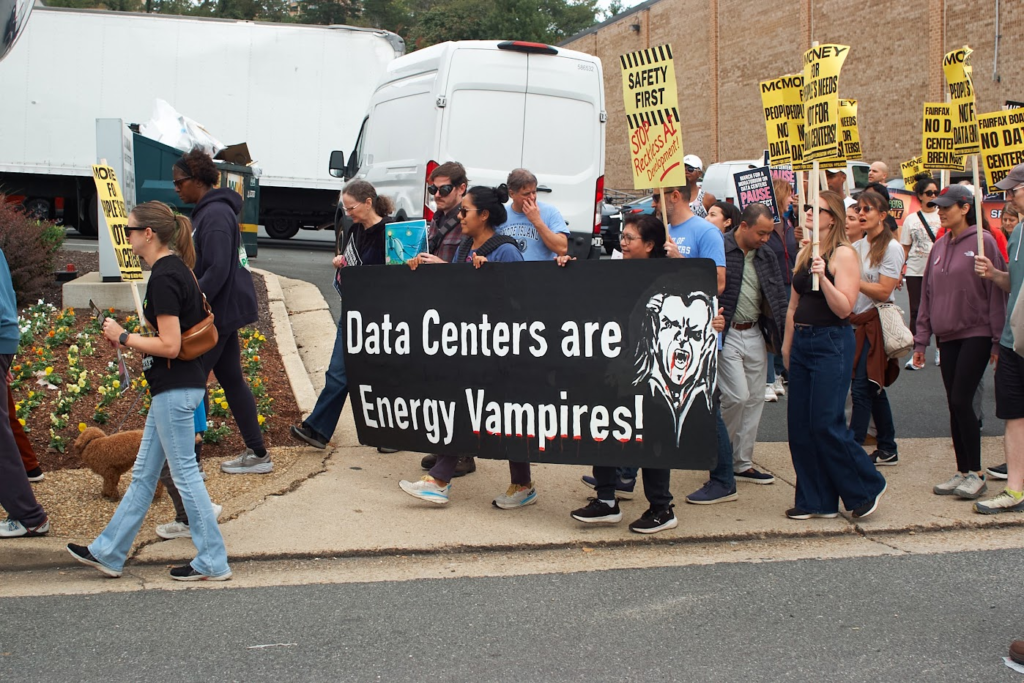
About 200 people – young activists, older adults, and parents with strollers – came out to a rally and march on Oct. 10 to show their support for a moratorium on data centers in Virginia.
The event took place outside the Plaza 500 site in the Bren Mar Park community where Starwood Capital is planning to build a huge by-right data center complex next to residential neighborhoods. A substation to serve the data center has not yet been approved.
The March for a Moratorium is the first of a two-week campaign launched by the Chesapeake Climate Action Network (CCAN) Action Fund and its partners calling for Virginia leaders to pause new data centers across the state until protections are put in place to address energy demand, water use, pollution, community impacts, transparency, and rising electric bills.
“The Plaza 500 proposal exposes the full danger of unchecked data center expansion,” said Tyler Ray, founder of the Save Bren Mar Coalition. “We need an immediate moratorium, so state and local leaders can establish tough guardrails.”
Related story: BoS backs data center industry on substations, rejects residents’ concerns
“Approving projects of this scale by right without public hearings cannot stand. Local elected officials are ceding their oversight under outdated rules simply to benefit deep-pocketed developers,” Ray said. “Without statewide action, our communities are left entirely at the mercy of data center developers, Dominion Energy, and the elected officials are prioritizing corporate interests over residents.”
“Communities across the Commonwealth are fed up,” said Victoria Higgins, Virginia director at the CCAN Action Fund. “Data center impacts on clean air, water reservoirs, household energy bills, and neighborhoods have been left unaddressed for years. Across cities, suburbs, and rural localities, and across all political ideologies, Virginians have been very clear: pause data center approvals until we can truly protect communities.”
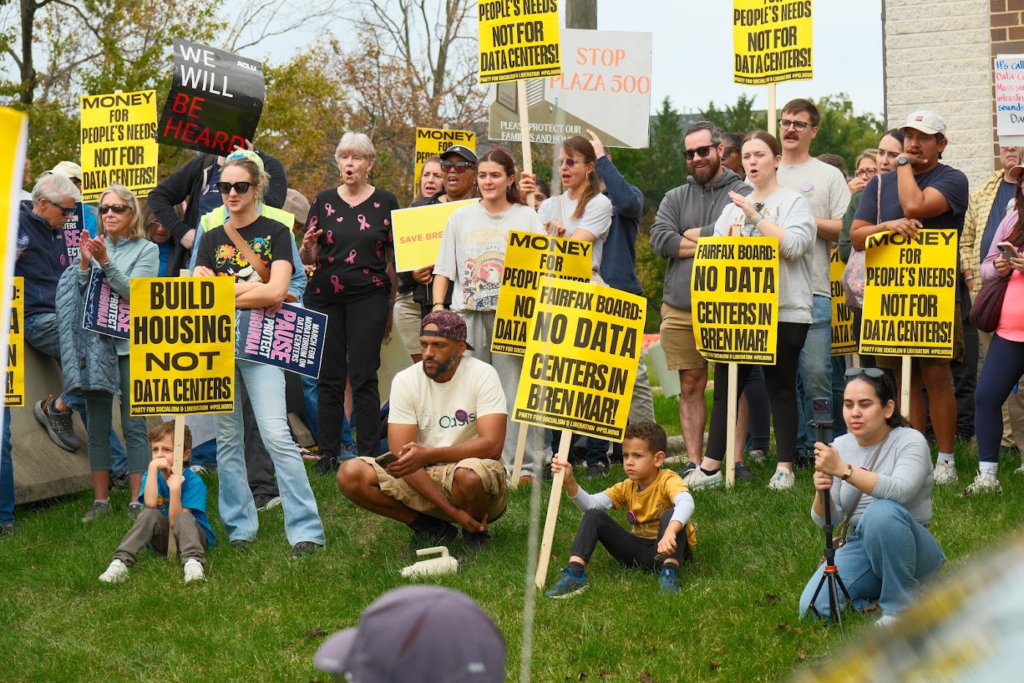
Virginians are “tired of a system where Big Tech can do whatever they want without consequence – building data center after data center in community after community while we pay higher energy bills, breathe dirtier air, and watch our drinking water go down the drain,” said Jordan Seurattan, Northern Virginia field manager for the Virginia League of Conservation Voters.
“Plaza 500 is the poster child for where NOT to place a data center and substation,” said Whitney Redding, director of Friends of Holmes Run. “It’s too close to high-density residential. It’s on a parcel that was supposed to be protected from such intensive impacts because of two streams that contribute to our drinking water.”
“Data center land use decisions are local, but their impacts extend well beyond the nearest neighbors and local environment to those of us living downstream or downwind,” Redding said. “That includes the City of Alexandria and anyone who pays an electric bill. This is why we need a moratorium.”
Related story: Spanberger releases plan on data center accountability
“We can’t continue rolling out the welcome mat for data center developers at the expense of communities and the environment that sustains us,” said Renee Grebe, Northern Virginia conservation advocate at Nature Forward. “Virginians are already dealing with the negative impacts of the data center build-out, from cumulative air pollution to constant noise and fractured natural and human communities – all done with little transparency.”
“The health impacts on our kids from data center diesel generator emissions are unacceptable,” said Bobby Monacella, senior campaigner for Mothers Out Front. She pointed to a recent study that estimated the emissions from these generators could trigger roughly 14,000 episodes of acute asthma symptoms annually in surrounding residential areas.
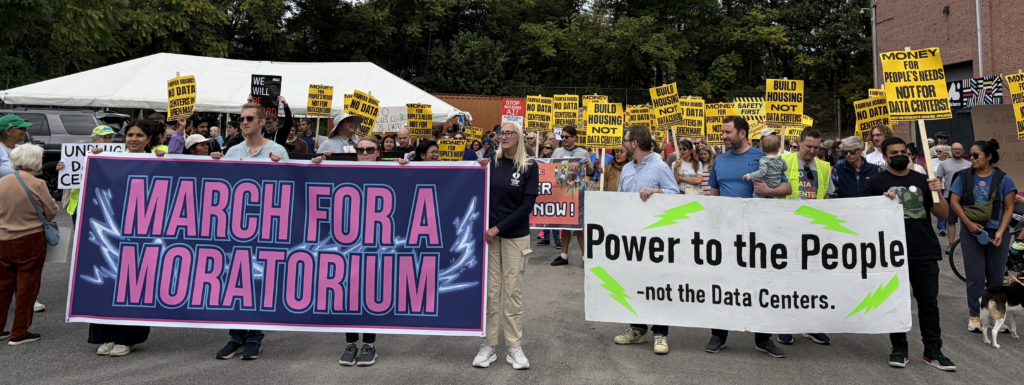
Noting that the proposed substation on Edsall Road is just 67 feet from people’s homes, Cesar Madison-Tapia, an educator and Army veteran, said, “What is the price of progress when the people paying that price are the families who live next door?”
“Imagine working your entire life to purchase a home. Imagine raising your children there, building memories, and planning your future. And then discovering that major electrical infrastructure could be built practically in your backyard,” Madison-Tapia said.
“And when you raise concerns about your health, your environment, and your neighborhood, you’re told this is the price of progress,” he said. “Economic development should never come at the expense of the people it is supposed to serve.”
Alexandria City Council members Abdel-Rahman Elnoubi, Sandy Marks, and Canek Aguirre also spoke at the rally.
The next stops on the Virginia March for the Moratorium campaign are Winchester on Oct. 15, followed by Leesburg, Culpeper, Danville, Virginia Beach, Roanoke, and Richmond.