
Route 7 BRT project advances
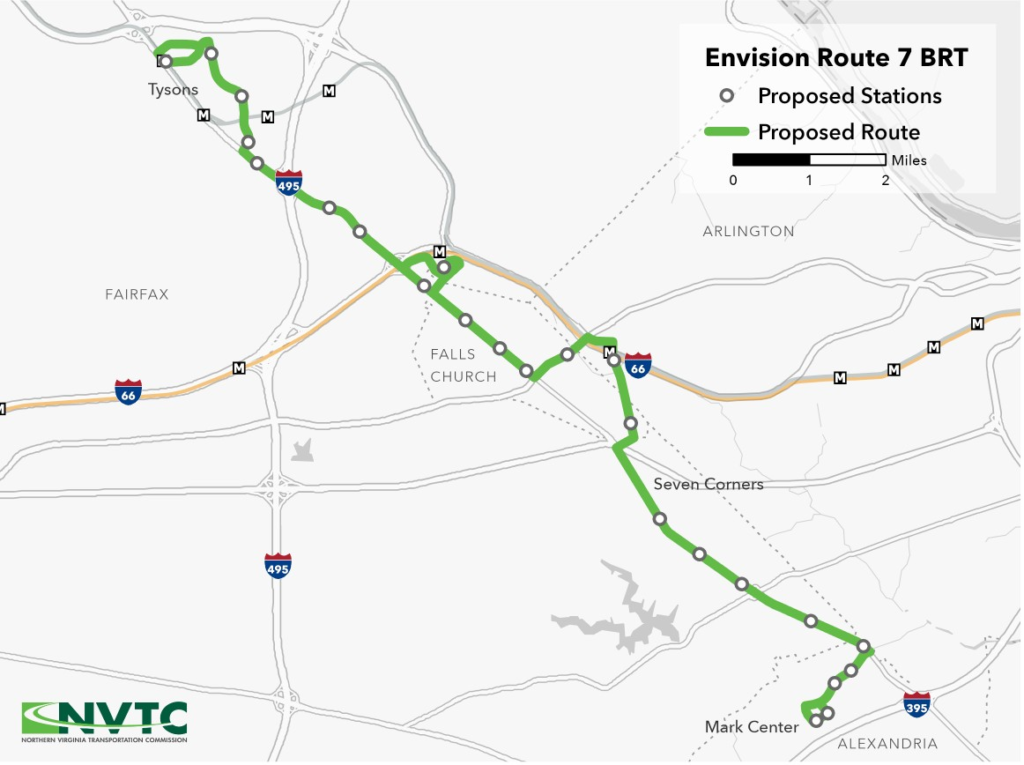
The Envision Route 7 project has advanced to the mobility analysis phase for the segment through Bailey’s Crossroads and Seven Corners.
The project, led by the Northern Virginia Transportation Commission, calls for a bus rapid transit (BRT) route along a 14-mile corridor along Leesburg Pike between Tysons and either the Mark Center or the future Southern Towers Transit Center. The route would also connect with the East Falls Church Metro station.
A BRT would run more frequently than a regular bus and would travel on dedicated lanes where possible. There would be enhanced bus shelters along the route.
The analysis during Phase 4-2, currently underway, is looking at spot improvements that can be accomplished in the near term, said Senior Program Manager Vikram Sinha at an open house on Envision Route 7 on Oct. 15 at the Culmore Community Library.
Examples of interim targeted improvements could include transit signals that give buses a head start and painting bus lines red to designate them as bus-only.
Those types of changes would lay the groundwork for the more capital-intensive work to complete the BRT system.
Related story: Federal funds approved planning Envision Route 7
The Phase 4-2 analysis could be completed by the end of 2026, Sinha said. The enhanced bus stops will take about three years to implement.
According to Sinha, the NVTC is proposing a dedicated bus line where feasible. There are no plans to widen Route 7, so the traffic configuration would have to change, resulting in fewer or narrower travel lanes. The bus lane could be open to regular traffic during peak hours.
The NVCT has identified the location of 23 potential bus stops along the Route 7 corridor.
The BRT would be run by the Washington Metropolitan Area Transit Authority and would not replace existing Metrobuses, Sinha said.
BRT riders would most likely wait no more than eight minutes for a bus, he said, although buses would run less frequently after 8 p.m. Rather than having a single BRT bus traverse the whole 14-mile route, there could be two routes that meet in the middle, Sinha said.
Additional issues to be resolved during Phase 4 include transit connectivity between the Columbia Pike and Route 7 bus routes and alignment between the BRT and the 28A Metrobus route along Leesburg Pike.
By the end of 2026, the NVTC hopes to secure financial commitments for the project from the four affected jurisdictions: Alexandria, Fairfax County, Falls Church, and Arlington.
So far, $3 million has been committed for planning and design, including $2 million from the federal government, $500,000 from the Virginia Department of Rail and Public Transportation, and $500,000 from local sources.
At the open house, transportation planners from the NVTC and other agencies solicited feedback from the public on how they travel along Route 7 and what improvements they would like to see. Residents are encouraged to submit input here.
In an unrelated issue, a new signal has been approved for Route 7 at the Glen Carlyn Drive/Magnolia Avenue intersection, said Michael Garcia, chief of the Transportation Planning Section at the Fairfax County Department of Transportation. That project hasn’t been funded yet, however.
Related story: Funds approved for Seven Corners Ring Road
Additional Route 7 projects are in the works, including the Seven Corners Ring Road, which is aimed at reducing traffic congestion where Route 7, Route 50, and Wilson Boulevard converge. So far, $133 million has been awarded for that project in state, local, and Northern Virginia Transportation Authority funds.
The first phase of the ring road calls for a wider road with bike lanes and wider sidewalks on the west side of the interchange along Castle Place. That road would connect Route 50 and Route 7, crossing Sleepy Hollow Road. It would displace the Public Storage building at 6319 Arlington Blvd.
Garcia anticipates construction of that segment of the ring road could start in 2030 and will take five to eight years to complete. That project calls for extensive property acquisition and utility relocations, he said, so there are a lot of “unknowns” that could affect the schedule.
Oh gee, a new bus route. How earth shattering. Way to “envision” route 7.
Thanks to the luminaries for that Phase 4-2 analysis.
The most inconsequential article I’ve read all week.
Sounds much like metro through Tysons, it will be partially executed to save cost and end up disrupting traffic flow. Then it’ll only be used by people who don’t drive anyway and it’ll do nothing to reduce traffic. This sounds nice – but at either end of the route, it’s a dead-end, a bus to nowhere, or are there direct connection to jobs, airports, Tysons, old town, Arlington center, pentagon? Trying to urbanize an area that was designed as a suburb.
This is one of the most heavily used bus routes in the region. It connects two heavily used endpoints in Tysons and the Mark Center, a major employer (although I do wish that this integrated with the Alexandria route for a one-seat ride to King Street).
IMO the main problem with this project is that they keep watering it down. It should be a light rail connecting the missing stretch between the two metro lines with better frequency and capacity. This would make transit a reasonable consideration for far more households that are either fully car dependent or multiple bus transfers away otherwise. Then the bus operating budget can be focused on connecting to these core lines for surrounding neighborhoods.