
Rule changes would make it easier to establish an ALU
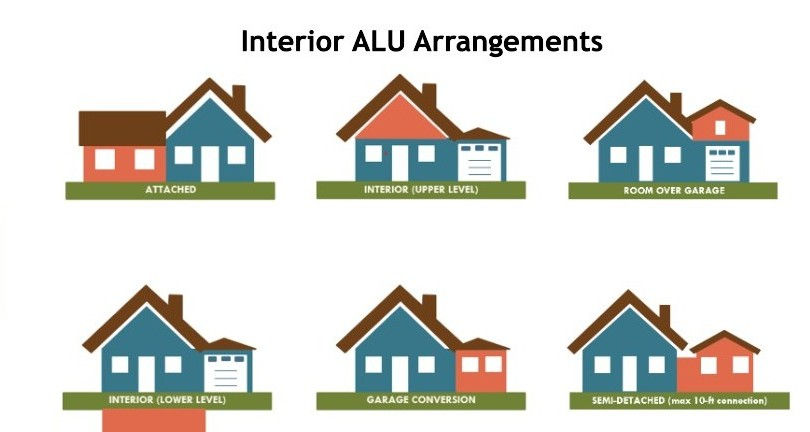
Too few homeowners have gotten their permits approved for accessory living units (ALUs) or found the regulations too difficult, so the Department of Planning and Zoning is proposing rule changes to eliminate some of the barriers and streamline the review process.
Carmen Bishop and Casey Judge of the Zoning Administration Division explained some of the changes under consideration during a virtual community meeting on Jan. 21. There will be another meeting today, Jan. 22, at 7 p.m. Access the meeting here.
A survey will be posted on Jan. 22, with a Feb. 28 deadline for responses.
At the same time, several pieces of legislation are being introduced in the General Assembly to require localities to allow ALUs and make it easier to approve them.
Under Fairfax County’s Zoning Ordinance, there are two types of ALUs: An interior ALU inside a single-family home can be approved with an administrative permit. A detached ALU can only be approved on a lot of at least two acres and requires a special permit approved by the Board of Zoning Appeals.
An ALU must include separate areas for eating, cooking, sleeping, living, and sanitation. A homeowner could develop an ALU to provide a separate living space for an elderly relative or an adult child, or for rental income.
Between July 1, 2021, when an overhaul of the Zoning Ordinance loosened the rules for ALUs, and Oct. 31, 2025, only 158 of the 407 ALU permit applications submitted were approved. Another 69 ALUs that had been approved weren’t renewed after the two-year permit period expired.
One recommendation under consideration would allow certain detached ALU proposals to go through an administrative permitting process rather than a special permit.
“When people see there is no path forward for a detached ALU, they abandon the idea or try to be creative,” Judge said.
Related story: Streamlined rules proposed for accessory living units
Zoning officials are also considering eliminating the two-acre minimum lot size for detached ALUs. As Bishop noted, most single-family homes are on lots that are less than a quarter of an acre.
Another proposed change could allow detached ALUs to be up to 50 percent of the size of the principal dwelling. The current standards limit detached ALUs to 1,200 square feet.
Bishop said staff are looking at new standards for semi-detached ALUs connected to a home via a breezeway or hallway.
Also under consideration: remove of the requirement that ALUs must be renewed; review an interior ALU application as part of the building permit application, rather than require a separate administrative application; and eliminate the parking requirement.
Current rules require at least one additional off-street parking space – in a driveway or garage – for an interior ALU.
An architect at the community meeting who works with property owners on ALUs called the parking requirement “a poison pill that makes this not feasible.” Another participant said eliminating the parking requirement would make already-overcrowded streets even worse.
Would ALUs be considered affordable housing? No, Bishop said. They are market rate but would help increase the supply of housing. An ALU could have a lower rent as it wouldn’t have amenities like apartments. As a result, an ALU could allow a family to live in a neighborhood that might not be otherwise affordable.
Updated ALU rules are expected to be drafted this summer, with public hearings scheduled for next fall or winter.
Yesss! Relax the rules and regulations on ALUs and they could actually be created! The two-acre rule and parking rules are perposterous. The few folks who have two-acres probably don’t even want an ALU or need the income from it. I have a corner house with plenty of room on my side lot for an ALU, but I’m under half an acre. Additional ALU and housing benefits many, and will open up for rental options for folks. Apartments are getting way too expensive and aren’t a good living experience, a detached place is the way to go.
Bangalore here we come!
These could work in some locations. But many homes in this county are still on septic so that could be an issue. I also worry about tree canopy and parking overload on side streets. I have no objection to these generally but do think these questions should be addressed before these are built and not just rubber stamped without due diligence.
The survey is misleading. It presents 3 scenarios, none of which reflect the cumulative effect of the proposed amendments. First, they assume an ALU of 600 square feet when double that area is permissible now. Second, if the permitted ALU size is a percentage of the primary dwelling and/or expands the number of occupants, the size could be 2500 square feet or more depending on how big a developer makes the primary 3 story residence. Reducing the acerage means 2 substantial dwellings could be built on one lot. Look at the graphics and then imagine an ALU twice or three times as large. If there is a requirement for parking spaces, then imagine how that would look. Then ask if you want that next door and vote accordingly. These initiatives all seem like they could be good ideas, but it can and will be abused. What you will get: More overcrowded boarding houses because the more money can be made cramming people into basements and cheap ALUs than selling to families in search of affordable starter homes. Equally predictable is developers cramming 2 or more comparatively large buildings onto what is now a single lot. Missing middle in Arlington has produced miĺlion dollar plus multi-family units and driven up real estate prices on modest entry-level homes. Don’t be misled by good intentions.
The county doesn’t enforce the current occupancy codes for single family houses and now we’re going to allow more density in single family neighborhoods.
Stop trying to end single family neighborhoods!
You’ll own nothing and be happy