
State withdraws $60.5 million in loans approved for Lake Accotink dredging
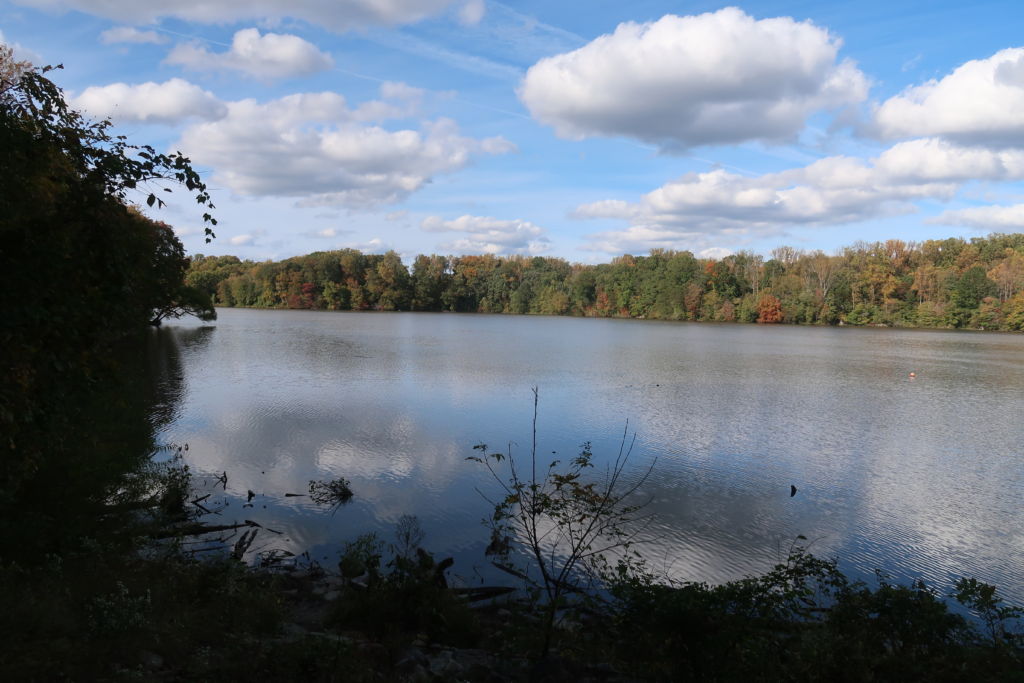
The Virginia Department of Environmental Quality has withdrawn $60.5 million in construction loans previously allocated for dredging Lake Accotink, the Fairfax County Department of Public Works and Environmental Services announced.
“DEQ confirmed that this action does not affect Fairfax County’s ability to reapply in the future,” states a Dec. 5 email from Lake Accotink Project Manager Turgay Dabak.
DPWES, in coordination with the Park Authority, will continue carrying out the Board of Supervisors’ direction to evaluate the feasibility of preserving a smaller Lake Accotink, with study completion expected in 2027.” Dabak states.
Related story: A fix for Lake Accotink is years away
“DPWES will continue pursuing alternative funding sources, including grants, low-interest loans, and partnership programs to support the project once the board identifies a path forward after current studies conclude,” he says. “Furthermore, DPWES plans to reapply for Virginia Clean Water Revolving Loan Funds once the project nears construction, aligning with the loan program requirements.”
The Department of Environmental Quality had previously approved two allocations from the Clean Water Revolving Loan Fund, including $30.5 million in 2020 and $30 million in 2021, based on initial dredging cost estimates.
“Because construction is now projected to begin no earlier than 2027, the project no longer meets federal and state requirements requiring fund drawdown within 24 months of award,” DPWES says. DEQ denied the county’s request for an extension based on an updated schedule.
Related story: More transparency needed on Lake Accotink preservation study
To the Board of Supervisors, we’re not citizens, we’re walking ATMs with voter IDs. Every time the Good Idea Fairy drifts into a meeting with another overpriced boondoggle dressed in buzzwords, the County Commissioners applaud like it’s Christmas morning, on the taxpayer’s dime. Ladies and gentlemen, the Lake Accotink project: a $30 million dredging turned into a $400 million fantasy so over the top even Disney would call it unrealistic. The only thing more endless than their spending is their belief that our wallets never run dry.
I’m confused about how the Board of Supervisors is relevant to this news.
Or where the $30M or $400M comes into it.
The project was originally estimated at $30 million. Now it’s $400 million. The Board of Supervisors are responsible for the budget.
The $395 million was the estimated cost to dredge/maintain the Lake for 20 years. It’s not a small sum, but the estimates were not made in good faith and were the maximum amount the Dept of Public Works thought they could propose to incite anger and dismay rather than laughter at their unprofessional proposals and calculations.
That is not accurate. The $395 million figure is very recent, and it appeared only after the consultants updated the project with new sediment volumes, disposal costs, and inflation modeling. It was never the number “for 20 years.”
When the county first presented a formal dredging plan in 2019, the public was told something very different. Annandale Today’s headline at the time was: “County proposes $30.5 million plan to save Lake Accotink.” That is what residents saw in black and white.
Only after 2019 did the estimates begin to rise. They increased to about $60 million, then to $95 million for the initial dredge alone, and eventually to $395 million over 25 years once long-term maintenance dredging was added. Those numbers did not exist 20 years ago. They did not even exist five years ago.
So if anyone claims that “it has always been $395 million,” they are rewriting history. The community signed on to a $30 million plan. The $395 million figure is a late arrival, and it represents a completely different project than the one originally presented to the public.
And they are in study number what, and each study cost the Fairfax County tax payers how much?
At all levels, you get the governance that the majority of people elect. That’s why it is important to vote. It is the peaceful way to protest or support the actions or inaction of elected officials and government.
The reality here is that Lake Accotink is a mega-sized stormwater management pond for the region and should not be financed as a project, but as a utility. It’s environmental purpose warrants some consistent funding for a sustained, low-impact dredging operation that keeps pace with sedimentation. The recreational benefits will be realized when the depth, water quality and dam maintenance issues are managed for the long haul. Or, we could just legalize gambling within the 10 foot contour of depth and license a casino to do what it takes. MGM Riverboat Casino and dredging! I can see it now! Jokes aside, the lake and bike path are some of the best recreational features in the area and shouldn’t be an afterthought. It serves a diverse set of communities and checks all the good boxes for quality of life. It shouldn’t be this hard.
This is exactly correct.
The sedimentation of Lake Accotink has been greatly accelerated by run-off water from the I-495 Express lane project. This has been given some small scale attention with rip-rap in the immediate vicinity of the highway, but the run-off grows downstream, and causes major soil loss and silt deposits in the lake.
The county should work to get funding to clean up the environmental damage caused by the 495 Express Lane project.
Your comment actually contains a fair amount of truth, along with some well-placed humor. Lake Accotink really does function as a regional, mega-sized stormwater management basin, and treating it as a discrete “project” rather than a long-term utility is part of the problem. Its environmental purpose alone justifies a steady, predictable funding model that supports an ongoing, low-impact dredging schedule that keeps pace with sedimentation instead of letting the lake lurch from crisis to crisis.
If you manage depth, water quality, and dam integrity over the long haul, the recreational benefits take care of themselves. And yes, the casino joke is funny, because it illustrates the absurdity of how complicated this has become. MGM Riverboat Casino and dredging… at this point, it feels more plausible than the county’s planning process.
But the serious point stands. The lake and the surrounding trail network are some of the best recreational assets in the region. They serve a diverse community and genuinely improve quality of life. They should not be treated as an afterthought. It really should not be this hard.
Lake Accotink is a beautiful gem in the heart of a busy overdeveloped suburban area. We need to preserve and protect it.
I would return it to a natural stream it was before the US Army Corp created it. The FFX County Parks has many beautiful parks with streams through them and this should be what it is returned to. Artificial lakes limit or prevent fish spawning in their normal upstream habitat. Birds loves streams as well. There will still be plenty of wildlife. The trails will still be around.
And in this economy, I think it’s absurd to continue with a huge recurring dredging cost.
Yes! eventually…. There is a part of me that agrees with this and would prefer the result, but I think this would be the most expensive in terms of single project costs, admittedly it would be lower cost over time.
My other concern is it does not address the reality that this stream is draining an urban environment and the sediments and contaminants in the current deposits and future runoff would be detrimental to the lower creek, river and bay. If you are going to go back to nature it seems you will have to go all the way or find some other way to slow the flow and catch the gunk, which will likely cost more than maintaining the lake.
When this area of the county was developed there was little concern for or awareness of Storm Water Management (SWM) issues and their ecological effects, likely leading to the bulk of the sediments filling the lake. For this reason, the lake unwittingly helped keep the Potomac cleaner than would otherwise have been the case. As max density of development in the watershed is approached and the construction regulations have matured (and the Beltway is done for now!), one hopes the pace of sedimentation is slowing and a system that stays slightly ahead of deposition could grind on the problem.
So, while I don’t disagree in concept, I do think we are in a “you broke it you bought it” phase of things and we need to settle in on doing what needs doing right now. Once the deep deposits are gone or stabilized and the upstream SWM aspects are better addressed, your idea would become much more feasible and at that point, preferable (although I do like to canoe around the lake and would miss that).