
Fairfax County assures voters that election security measures are in place
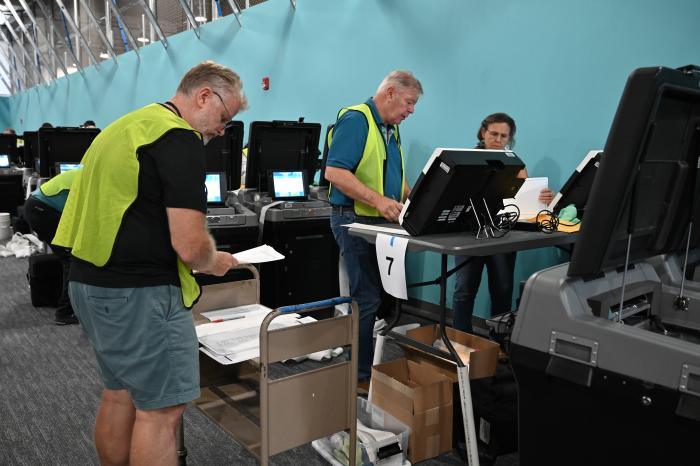
With Election Day just three weeks from today – and early voting already underway – Fairfax County wants the public to know that strict security measures are in place to protect ballots and voting machines.
Members of the U.S. Senate and House are on the Nov. 3 ballot, along with three constitutional amendments and two Fairfax County bond issues. Early voting at the Mason District Government Center and Thomas Jefferson Library starts Oct. 22.
Secure ballots
Ballot drop boxes are physically secured with padlocks, and ballots are retrieved from drop boxes multiple times a day, the Fairfax County Government reports. The 24/7 drop box at the Fairfax County Government Center is under video surveillance.
Two election officials transport ballots collected from early voting and Election Day drop boxes in sealed containers to the Office of Elections.
Once there, each transfer step is documented, ensuring that every absentee ballot is accounted for and properly stored.
Voting machines
Fairfax County uses DS300 and DS950 ballot scanners that are certified at both state and federal levels to meet required standards for accuracy and security. Before each election, these machines undergo rigorous logic and accuracy testing to verify their ability to read and tabulate ballots correctly, the county states.
Election officials check hardware and software to ensure proper functioning and check that security measures are working to prevent unauthorized access. Representatives from political parties are invited to observe these tests to ensure transparency.
A key security feature of these voting machines is that they do not have modems or wireless capabilities, such as Wi-Fi or Bluetooth. This means the machines cannot be hacked or tampered with remotely.
Related story: Three constitutional amendments will be on the Nov. 3 ballot
The machines’ digital scanners capture an image of the front and back of each ballot while tallying the votes.
After voting ends, results and ballot images are encrypted and securely stored on proprietary USB drives that are transported to election headquarters by two election officers using chain of custody protocols. Voted ballots are sealed in boxes, labeled for tracking, and transported to secure storage at the courthouse.
Virginia’s statewide voter database tracks every voter who casts a ballot. Once a ballot is submitted – whether in person, by mail, or through early voting – it is recorded in the database and pollbook. That prevents the counting of additional ballots under the same voter’s name.
Counting ballots
Absentee ballots and votes cast on Election Day are reported after the polls close. Results are not final until all absentee and provisional ballot submissions are in.
Virginia law allows absentee ballots postmarked on or before Election Day and received by noon on the Friday after to be counted. Provisional ballots are processed in the days following the election, and accepted ballots are tallied by machine and added to the vote totals.
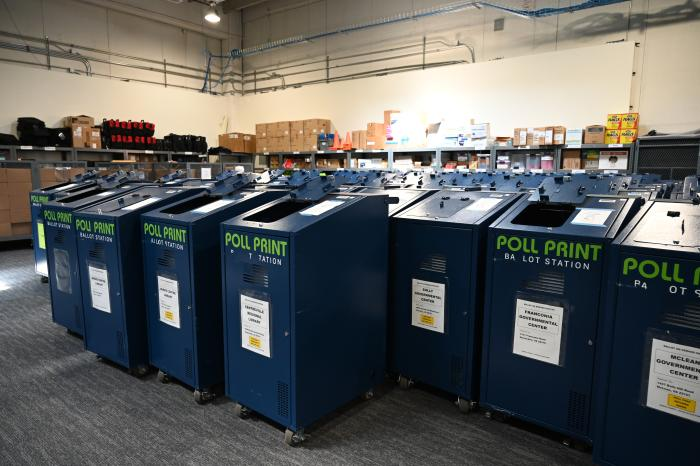
With more than 800,000 registered voters in Fairfax County, the largest jurisdiction in Virginia, accurate tabulation takes time.
Election Night results are preliminary until all absentee and provisional ballots are counted. Once tallied, the Electoral Board can certify the final counts, which must be submitted to the Virginia Board of Elections by the second Friday after the election.
The post-election canvass is a critical step in ensuring the accuracy and integrity of election results. After Election Day, a canvass reconciles the total ballots cast with the number of voters, and confirms that the data from voting machines matches printed reports. All valid ballots are included in the final count, and any discrepancies are addressed before certification.
The Office of Elections also conducts periodic risk-limiting audits as directed by the State Board of Elections, comparing a random sample of paper ballots with voting machine results for accuracy. Post-election audits are conducted with election officials, neutral observers, and party representatives present.