
Supervisors raise concerns about Flock cameras
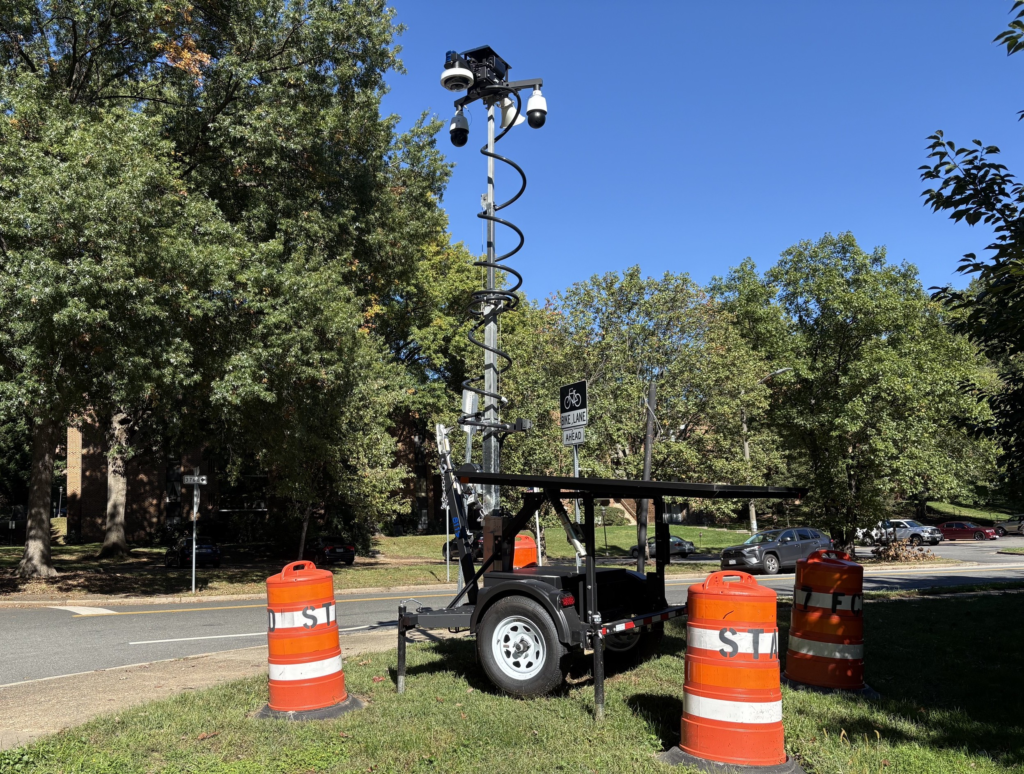
Fairfax County Police Chief Kevin Davis told members of the Board of Supervisors that its system of automated license plate readers from Flock Safety has been highly effective in solving crimes.
While FCPD maintains it has guardrails in place to prevent misuse, several supervisors expressed concerns about privacy, the retention of data, the sharing of data with other agencies, and Flock’s use of artificial intelligence.
Davis and other FCPD leaders gave a presentation on ALPRs at a meeting of the board’s Safety and Security Committee on Oct. 20. Last month, the board approved a motion to pause the installation of new Flock ALPRs pending consideration of further action.
Local governments throughout the country are taking down their Flock ALPRs in the face of growing opposition among the public about misuse of the data.
The Fairfax County Police Department operates 84 Flock Safety ALPR cameras. FCPD places the cameras in high-crime areas and moves them around as needed. There also are 714 Axon Fleet 3 ALPRs installed in police vehicles.
Crime fighting
Major Hudson Bull, commander of FCPD’s Real Time Crime Center, told the board that since Nov. 1, 2022, ALPRs have helped the police recover 572 stolen vehicles, make 2,672 arrests, recover 67 guns, solve 161 narcotics cases, arrest 938 suspects, and locate 60 missing persons.
The highest concentration of Flock cameras is at the Tysons, Springfield, and Fair Oaks shopping malls. “We’ve seen a significant reduction in crime around those locations,” Davis said.
Bull highlighted several success stories facilitated by Flock ALPRs, including the arrest of a suspect who exposed himself on school grounds, the arrest of a suspect who tried to lure two children into his car, and the location of a suspect who shot and killed his former partner outside her workplace.
Related story: Supervisors pause new Flock cameras
According to Bull, the police department restricts who can access Flock data, and officers never conduct searches for immigration enforcement purposes.
The system can flag suspicious activity, such as whether a detective searched the same plate numerous times in the past 30 days.
The FCPD presentation offered three options for moving forward:
- Maintain the current Flock Safety ALPR program and continue to evaluate other vendors and data-sharing practices.
- Maintain the current ALPR program while testing and evaluating other ALPR vendors who can maintain compliance with Virginia law § 2.2-5517 on ALPRs and FCPD’s policies and operational guidance on ALPRs. The state law, enacted in 2025, restricts the sharing of ALPR data outside Virginia and prohibits sharing data with federal agencies.
- Become a closed network ALPR system with no data sharing outside Fairfax County while maintaining access to privately owned ALPR cameras. Evaluate the closed network option in one year.
Supervisor Rodney Lusk (Franconia), chair of the Safety and Security Committee, acknowledged the effectiveness of ALPRs in fighting crime, but said “I’m still struggling with how we should evaluate Flock technology in light of the concerns we’re hearing from the community.” He suggested re-evaluating the policies and procedures around the number of cameras, the number of officers with access, and the length of time the data is retained.
In response to the three options proposed by the police, Supervisor Andres Jimenez (Mason) offered another alternative – “how about no ALPR system at all.”
Data sharing
In addition to the cameras operated by the police, there are at least 120 privately owned Flock cameras operated by HOAs and businesses. Those are just the ones FCPD can access; there are probably more, Bull said. As they are privately owned and on private property, they can share their data with anyone.
Lusk questioned why FCPD retains ALPR data for 21 days, while the Flock default is seven days.
The Police Department originally retained the data for one year, later reduced it to 30 days, and now Virginia law sets a limit of 21 days.
If someone’s home is broken into while the owner is on vacation, any image of vehicles in the area will be gone by the time they get home and discover the burglary, Davis said. “It takes time to gather information that led us to a certain vehicle. After 21 days, it’s gone,” Bull added.
However, Bull also said that images considered as evidence in serious crimes can be retained for much longer periods.
Related story: DeFlock Fairfax wants FCPD to take down its license plate readers
Several supervisors raised concerns about data sharing with other jurisdictions and what level of access other agencies have to FCPD data. Some law enforcement agencies are not in compliance with the law.
Bull said the prohibition on sharing data outside Virginia “makes it very restrictive because we often see crimes connected to D.C. and Maryland.”
A surveillance state
Questions were also raised about how Flock’s AI tool for auditing the data is used.
There is a human component to the auditing process, Bull said. A five-member team reviews the audits, looking at who conducted the search, what crimes they were looking for, and why it made sense to do a search at a particular location. The searches that get flagged are audited again.
Supervisor James Bierman (Dranesville) noted that Flock is able to track individuals, not just cars. The systems could be used to show how often someone visits a liquor store or goes to a fertility clinic, for example, he said.
“I appreciate the guardrails, but there are other jurisdictions who thought that they had guardrails, but later found out there were backdoors into their system allowing other people to use their data,” Bierman said. “It concerns me when we’re working with a vendor that only cares when it hits their bottom line.”
“No one is doubting the technology can help solve crimes,” said Rachna Sizemore Heizer (Braddock). “We need to find the right balance.”
“The right to privacy is a constitutional right,” she said, while also raising concerns about data security, hacking, stalking, violence against women, and immigration.
And while Flock CEO Garrett Langley wrote in a letter to Board Chair Jeffrey McKay that Flock customers own and control the data, Sizemore Heizer said, Flock uses the data to check their system.
“It’s the development and implementation of the new AI tools that is the major concern,” said Walter Alcorn (Hunter Mill). “We have to make sure that we’re not enabling a surveillance state. We also have to make sure the data we collect is not being misused by others.”
Alcorn called for “a broader community conversation about digital law enforcement in the AI age.”
The discussion needs to be regional and should include civil liberties advocates, homeowner associations, and IT and data specialists, he said. “We really need to dive into it in a very public way.”
If you’re not doing anything wrong I don’t see a problem with them. Nothing is private everybody’s name address etc is all over the internet. I’ll be happy to share my driveway with a flock camera.
“If you’re not doing anything wrong, why does that bathroom have doors?”
So wise. Pay attention here folks
Founding principles of this country include liberty, freedom, presumed innocence, government is ours to control not vice versa.
Innocent people have been erroneously flagged by the Flock system for crimes for which they were later proved innocent. Some had been incarcerated for 13 days, some for 1 or 2 days just for having a similar (not exact) license plate to the actual vehicle involved in a crime.
Flock data is shared nationwide and kept forever despite what the local jurisdictions are promised. There are over 2 billion license plates read ever month and at least 20 million data errors. The errors can lead to arrests in cases when law enforcement does not perform due diligence verifying the accuracy of the Flock reports with other investigative data.
I don’t know if you are alright being locked up for a crime you did not commit but most of are not willing to forego our rights because an automated system and an incompetent or lazy law enforcement officer did not perform their job properly.
Anyone who actually drives around Fairfax County intuitively understands that having us FLOCKED has not made us safer.
I agree that the civil liberties issue is important, especially in this age of abuses by authorities, not to mention domestic abusers, stalkers, etc. However, can they use them to fine people barreling down streets like Braddock Road that pedestrians share? The speeds are alarming.
Speed ticket cameras and red light runner cameras are permitted. You could submit a request to your regions Supervisor to request that of FCDoT.
These cameras are an invaluable tool…as someone said earlier, if you’re not committing a crime, then don’t worry. Just look at the multiple crimes committed in Fairfax where the perpetrators then jumped into vehicles (some stolen) headed for DC or MD. We’re all pretty much on view anyway via the internet…so let’s keep a tool that works and stop worrying about over-surveillance.
Interesting that illegal dumping on Americana wasn’t the first place for a Flock camera? A toxic waste dump for poor people was not priority over paid tickets and someone’s stalking hobby.
Now I agree with this. And a big sign “This area is under continual surveillance.”