
Casino opponents dispute economic benefits
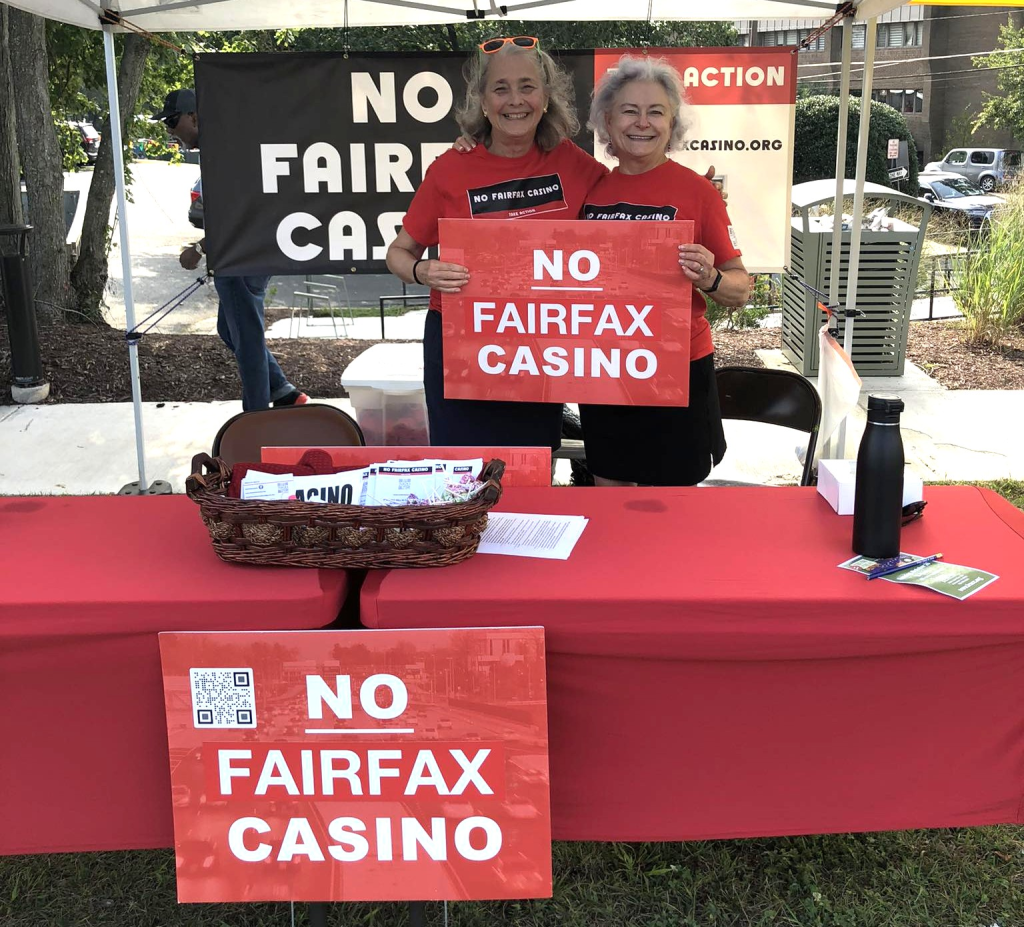
Now that another bill promoting a casino in Tysons will be introduced in the next General Assembly, opponents are gearing up again to fight it.
Leaders of the opposition presented their arguments at an online presentation on Sept. 24.
The legislation would authorize Fairfax County to hold a referendum on whether a casino and entertainment complex should be developed in Tysons.
A bill introduced in 2024 died in a Senate committee. A nearly identical bill introduced earlier this year by Sen. Scott Surovell (34th District) cleared the Senate but died in a House subcommittee. Surovell now plans to reintroduce the bill in the 2026 General Assembly.
A survey conducted for the Tysons Stakeholders Alliance in January found widespread opposition to a Tysons casino across Fairfax County.
A risky bet
Surovell claims a Tysons casino will generate $1.2 billion in revenue and $232 million in state tax revenue per year.
But Andy Pavord, the CEO of the Federal Consulting Alliance, questions that assumption and calls a casino “a risky financial bet for Fairfax County.”
According to Pavord, the experience of other casinos shows that the projected revenue is not a sure thing. He noted that a casino in downtown Chicago only generated 25 percent of the expected revenue in 2023 and only 47 percent in 2024.
Casino tax revenue has been flat or declining among every major casino in the country, Pavord said, due mainly to increased competition from online gambling and sports betting.
Among the negative impacts on Fairfax County cited by Pavord:
- Businesses and residents would be less likely to locate in Tysons, leading to a decline in property values. A 5 percent decrease in property values would lead to a $10 million decline in annual property tax revenue
- Money spent in casinos is not spent in local businesses. That would result in a loss of over $500 million in revenue for local businesses, and a loss of up to $150 million in tax revenue for the county.
- Fairfax County would have to spend more on services, such as police, traffic remediation, and counseling for gambling, drug, and alcohol addicts.
Moreover, the majority of revenue generated by a casino would go to the state, not Fairfax County.
Traffic congestion and crime
If a casino hopes to generate $600 million, it’s going to need to attract 25,000 visitors a day, Pavord said. That’s why most of the country’s biggest casinos, such as MGM in National Harbor and Foxwoods Resort in Connecticut, are not located near a business district or a residential area.
Tysons already has a problem with traffic congestion, he noted. “You can’t bring 25,000 people to a small space without a cost.”
Sally Horn, chair of the Greater Tysons Citizens Coalition and a member of the board of the Tysons Community Alliance. noted that more than 60,000 cars travel through the heart of Tysons every day, while a casino would add another 10,000 to 15,000.
As traffic worsens, drivers will cut through neighborhood streets, Horn said, while the number of intoxicated drivers is likely to increase.
Another problem is an increase in crime. According to Horn, counties that have a casino have seen property crime increase by 8.6 percent and violent crime by 12.6 percent. “Organized crime and human trafficking are often linked to casinos,” she added.
While Comstock Companies, the potential casino developer, promises higher-paying jobs, there is no guarantee that will happen. And once a casino is built, there would be no obligation for the company operating the casino to honor that promise.
Most casino jobs pay just $36,000 to $52,000 a year, she said, while the working conditions are stressful and there are few opportunities for advancement.
Horn also said gambling addiction is rising, and “gambling disorder is as addictive as heroin, cocaine, and opioids.” And that leads to financial and emotional consequences for families. In addition, she said, casinos are being used by cartels and terrorist groups to launder money.
Elected leaders’ positions
The panelists urged residents to reach out to county and state officials to express their opposition to a casino.
Paula Martino, president of the Tysons Stakeholders Alliance, outlined the positions of Fairfax County supervisors, based on their public statements.
Martino said Walter Alcorn (Hunter Mill), Jimmy Bierman (Dranesville), and Rodney Lusk (Franconia) all oppose a casino in Tysons.
Both Andres Jimenez (Mason) and Dalia Palchik (Providence) do not oppose giving the board the authority to launch a public referendum on a casino, Martino said.
Kathy Smith (Sully) said she opposed a casino in 2024, and Board Chair Jeffrey McKay has repeatedly said the board didn’t request the authority to hold a referendum on a casino.
The views of Dan Storck (Mount Vernon) and Pat Herrity (Springfield) are unclear, although Herrity accepted campaign contributions in 2025 from Comstock CEO Chris Clemente.
“If the Board of Supervisors makes a clear statement to the General Assembly that they do not want the authority for a referendum, this fight would end,” Martino said.
Among the Northern Virginia members of the state Senate, Jenifer Boysko (38th District), Adam Ebbin (39th District), and Saddam Azlan Salim (37th District) oppose a Tysons casino.
In addition to Surovell, senators Dave Marsden (35th District), Stella Pekarsky (36th District), and Jennifer Carroll Foy (33rd District) support a casino bill and have accepted money from Comstock.
In the House of Delegates, Vivian Watts (14th District), Marcus Simon (13th District), Mark Sickles (17th District), Kathy Tran (18th District), Paul Krizek (16th District), David Bulova (11th District), Holly Seibold (12th District), Irene Shin (8th District), Karen Keys-Gamarra (7th District), and Rip Sullivan (6th District) oppose the casino bill.
The views of Laura Jane Cohen (15th District), Karrie Delaney (9th District), Charniele Herring (4th District), and Dan Helmer (10th District) are unknown, Martino said. However, Cohen, Delaney, and Herring accepted donations from Comstock in 2025.
Leaders of the Tysons Stakeholders Alliance and the No Fairfax Casino Coalition will speak at a joint legislative subcommittee on Oct. 20 in Richmond in support of a proposal by Del. Krizek to establish a Virginia commission on gaming.
Claudia Diamond, president of the Westwood Village Townhomes HOA, called on casino opponents to speak out against the casino bill at PTA and community meetings and anywhere elected officials are present.
She said, “Community opposition has stopped harmful projects before, and we can do it again.”
Garbage idea to get money out of the pockets of county residents. Sure, people who want to gamble have to go to another county and that county gets the revenue benefit, let them. This will bring crime and deepen poverty. Maybe take a look at how well this has worked in other areas.
It’s a trick. Don’t be fooled. They don’t actually want a casino.
You’ll fight and fight then they’ll fake giving in saying okay, okay, you win! We’ll put in a data center instead.
Great article but with one glaring error. Four Supervisors have publicly said they oppose a casino — Walter Alcorn and Jimmy Bierman have publicly stated their opposition numerous times. Rodney Lusk sent a letter to Virginia House Majority Leader Scott stating his opposition when the Surovell-sponsored casino bill was under consideration in the House of Delegates earlier this year. Supervisor Kathy Smith expressed opposition at a BOS Legislative Committee meeting in 2024.
BOS Chairman McKay’s stated in letters to the General Assembly and to the media that the Supervisors have not requested the authority, there have been no substantive discussions with FFX Co state legislators or the apparent casino developer and it’s a bad financial deal for the County.
When 5% of citizens commit over 50% of violent criminal acts, and that 5% is statistically prone to problem gambling and largely resides OUTSIDE our area, then putting a casino in Tyson’s will attract these individuals to commit violent criminal acts against our residents in our neighborhoods.
Remember chicken little. “the sky is calling, the sky is falling”. Cloth your pearls and control my life. . https://www.americangaming.org/wp-content/uploads/2025/09/cgrt-jul25-staterev-table-1.jpg. Copy and paste the link to find the revenue of each state. Gambling is like prostitution. NIMBY but the oldest profession is NOT flat on its back. BUILD IT!
Uhhh… what? Is this written in some kind of code?
Casinos are always a sign of a jurisdiction throwing in the towel on durable, diverse economic development.
Fairfax should not be lulled into surrender.
I oppose a casino at Tysons or elsewhere within Fairfax County. Residents should not be confronted with the vice and criminality that a casino will undoubtedly bring to our neighborhoods. This is a quality of life issue as well as a public safety concern affecting all Fairfax County residents. Reject this casino.
Wasn’t a prostitution ring just busted in Tyson’s? Now a casino?
If we have a referendum for a casino,, I’m confident the people of Fairfax County will say no.
At the Taste of Annandale I asked Senator Dave Marsden if he still wanted a casino in our county and he said “Fairfax County is sunk, if we don’t have a casino.” Really, sunk?! His words. This is from a 78 year old that brags about arriving in Annandale in 1953 and he “knows what Annandale needs”. It’s also from a politician who received money from Comstock. For those who wish to gamble, there are options nearby. I believe the people of Fairfax agree that we do not want or “need” the revenue a casino would generate.
Right on about, Marsden! Three of the six senators representing Fairfax County, including Marsden, support the casino and have received campaign donations* from the developer, Comstock Holdings: Surovell-$120,000; Marsden-$24,000; and Pekarsky-$10,000….Just saying
*according to the Virginia Public Access Project (VPAP)
I wonder if the “No casino” advocates offer Marsden a larger contribution than Comstock, he will change his opinion? It’s hard not to be disappointed with Marsden’s hypocrisy. If he truly thinks that a casino is good for the county, why does he muddy his rationale by accepting money from a group that has a vested interest in developing a casino.