
Del. Watts outlines legislative priorities
The huge electoral win by Virginia Democrats earlier this year offers a big opportunity to get their legislative priorities enacted by the General Assembly. However, the continuing cuts in federal funding will pose a huge challenge to the state budget.
A Democratic agenda
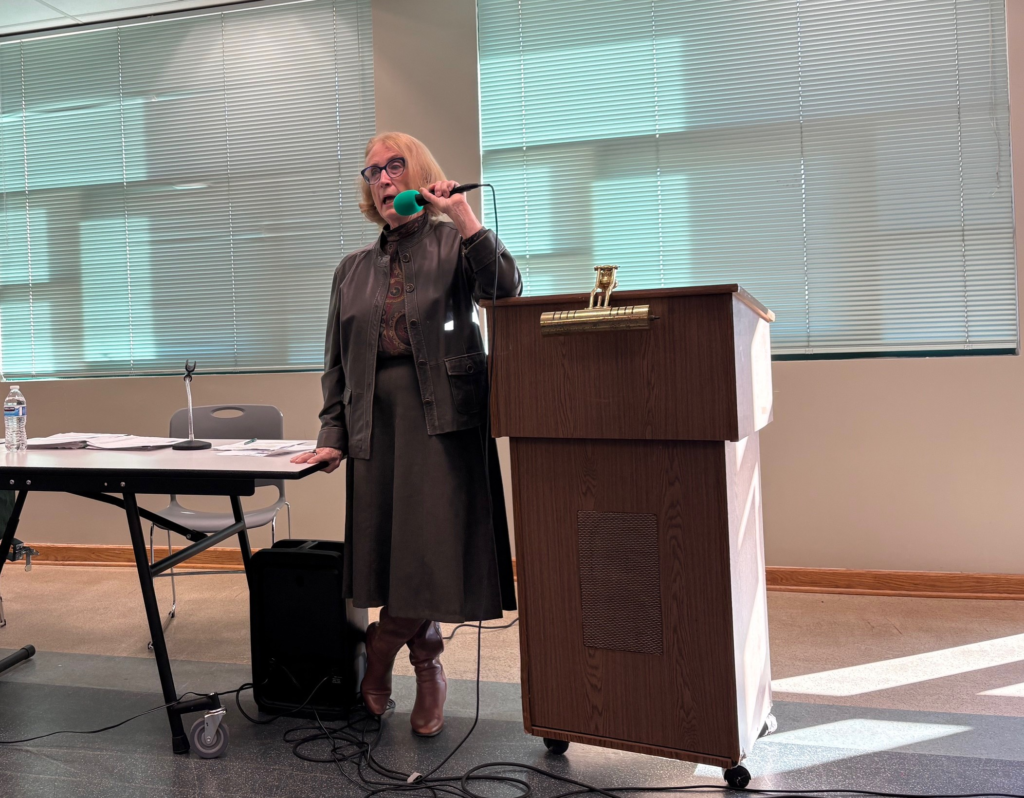
The Democratic victory “gives us the flexibility to really have a dialogue on some major issues,” Del. Vivian Watts said at a town hall on Nov. 16 at the Mason Government Center hosted by Indivisible NOVA. “I’m really looking forward to a productive session.”
In addition to sweeping the statewide offices – Virginians elected a Democratic governor, Abigail Spanberger; lieutenant governor, Ghazala Hashmi; and attorney general, Jay Jones – they picked up a bigger majority in the House of Delegates.
Democrats moved from 51 to 64 seats in the House. In the Senate, Democrats have a thin majority, 21 seats, compared to 19 Republicans, but Hashmi will have the tie-breaking vote.
The Democratic sweep also translates to the party breakdown in General Assembly committees, Watts said.
Watts, the longest-serving member of the House of Delegates, represents the 14th district, which covers Annandale, Lincolnia, and the Bren Mar Park areas.
She chairs the House Finance Committee and the Criminal Law Subcommittee.
Related story: Fired federal workers share their stories
Many of the bills passed by the Democrats last year were vetoed. Gov. Glenn Youngkin vetoed more bills than any previous governor by a long shot, Watts noted.
With Spanberger in charge, Democrats will have an opportunity to enact measures that were vetoed, ranging from protecting due process to restoring voting rights, supporting green energy, upholding academic freedom, protecting marriage equality, and promoting housing affordability, among other issues.
The window for action could be limited, however, as Virginia is the only state with a one-term governor. Watts has seen many governors come and go since she was first elected to the General Assembly in 1982, but says, “I’ve never seen anyone as prepared as Spanberger.”
Economic challenges
Watts said the federal employee layoffs and budget cuts imposed by the Trump administration are hitting Virginia harder than any other state. According to Watts, 25 percent of Virginia’s economy is dependent on federal spending.
Those cuts will put pressure on the state budget, especially for basic medical and food benefits. “We’re on a very serious downward path,” Watts said.
She said it’s critical to have a Democratic attorney general who is willing to sue the federal government against harmful federal actions, such as firing federal workers and cutting funds for Medicaid. That is something the current, pro-Trump attorney general refused to do.
Federal budget cuts for the SNAP program and Medicaid will drive up the cost of living for lower-income households. People without health insurance will end up in emergency rooms, which will lead to higher healthcare costs for everyone.
Changes in the federal Medicaid rules are increasing the administrative burden by requiring people to reapply every six months. According to Watts, that will also cut many people out of the program.
Funding for school meals is also declining, she said. Of the 11 elementary schools in Watts’s district, seven have more than 50 percent of students eligible for free and reduced-price meals. In three schools, it’s more than 70 percent.
The job cuts are not only taking a personal toll on Virginians, she said, but because many of those laid off were high-paid professionals, that will result in a decrease in the state’s revenue from income taxes.
At the same time, the increased tariffs are leading to big losses among farmers, while revenue from the port at Hampton Roads is down 8 percent.
Wealth disparity
The wealth and poverty gap has been growing for at least the past 25 years, Watts said. That will only increase, as Trump’s “big bill” continued the tax breaks for people at the upper income level. “We will have to deal with that on the state level,” she said. “We need to move the needle back toward equity.”
Watts expects legislation to be introduced raising the minimum wage, noting, “people in basic jobs need to be paid well.”
She supports a tax increase for people with incomes over $1 million or even $600,000. “I have no problem increasing taxes for people at that level,” she said, but doesn’t think Northern Virginia legislators will mess with the rest of the tax brackets.
The tax cuts approved last year and touted by Youngkin benefited higher-income people, she said. Only 10 percent of Americans file itemized tax returns, so the tax cuts don’t help anyone else.
Tax changes
Watts would like to see more diversity in state revenue. “It’s bad budgeting to depend on one tax,” she said. Seventy percent of Virginia’s revenue comes from income taxes. Unlike most states, Virginia doesn’t tax spending on consumer services. Taxing services would raise $2.3 billion a year, she said, but spending on health-related services should not be taxed.
Watts expressed caution on raising corporate taxes – currently at 7 percent – noting that it could cause businesses to leave the state.
A major priority of Northern Virginia legislators is pushing for changes in the state’s school funding formula, which dramatically underfunds schools in the region. As a result, Fairfax County has to make up the difference with the real estate tax.
Watts would like to see the estate tax reinstated. She has sponsored bills repeatedly to do that, but they haven’t passed. Currently, she said, 70 percent of an estate is passed on to the next generation tax-free.
The proliferation of data centers is driving up electricity costs statewide. Noting that Dominion has requested a 15 percent increase in the base rate, Watts would like to see the State Corporation Commission set a separate, higher rate for data centers.
Protecting immigrants
Several people at the meeting expressed concern about the federal government’s aggressive policies on detaining immigrants without due process.
“These are essential workers – particularly in agriculture – not an invading horde that has to be stopped,” Watts said. “If they’re going to be putting more money into ICE, it should be spent on more immigration hearing officers.”
She said it’s going to be up to individual jurisdictions to decide how to direct their police force on dealing with overly aggressive ICE agents.
There will be a major lawsuit addressing this issue when there is enough evidence to win in court, she said; however, getting it through the Supreme Court will be challenging.
Watts hopes Virginia will pass a law banning ICE agents from wearing masks and requiring them to wear a badge with their name.
Getting lawmakers’ attention
In response to a question about the need for limits on campaign contributions from corporations and individuals, Watts agreed it’s a serious problem – Virginia is only one of five states with no limits – but she doesn’t think it’s a top priority right now. She said candidates who fail to file a campaign finance report should be taken off the ballot.
When asked how members of the public can be the most effective in pushing their priorities, Watts said, “Numbers matter.” Sending individualized emails to legislators with details is effective, as is showing up at events, like the “No Kings” protests. “Showing that you’re paying attention matters.”
It’s critical to avoid violence and to ensure that political signs have the right message, she added. “Anytime there is any violence, it sets us back.”
Related story: Local residents turn out in force for No Kings rally in Annandale
Gee, what a surprise. Democrats first priority is to institute more taxes.
Virginia has had a surplus the past few years. Democrats did not want to cut taxes so they reluctantly returned $200 or $400 to people. Why do they need more taxes?
The Annandale Rotary Club is proud to have Del. Watts as a member. She recently participated in our Flags for Heroes initiative at the Annandale American Legion Post 1976 (featured in a past recent issue of Annandale Today.
Sincerely,
James Vance Holcombe, Jr.
President of the Annadale Rotary Club
No issue with having the billionaires and centi-millionaires pay their share of taxes. But regardless, the legislature needs to allocate smartly. Transportation is easy to identify – i believe I read that 80% of the funding raised by transportation/gas taxes comes from urban (Northern VA, Richmond, Hampton Roads), but the investment is skewed to rural areas. I’ve seen rural roads get paved regularly but potholes and pitted roads of our area take years to get done, pothole patches aren’t even guaranteed to happen annually. I don’t think allocating more funding to urban areas is going to happen as there are more delegates from rural areas than urban. That’s the same problem that is there with state education tax funding being spread heavily to rural districts from urban areas.
The delegates could stop VDOT from continuing to pursue road to bike lane conversions – high cost with minuscule usage. I would rather they take that money from converting Annandale/Gallows roads to more mass transit funding – either Metro Bus funding, or Fairfax Commuter bus. Those reduced traffic lanes make things worse and literally it’s our equivalent to the bridge to nowhere with the number of bike users that I’ve seen on the bike lanes on Annandale that have been in place for a few years.
Stop letting foreign companies run the outrageous tolls. Whenever that agreement end date is reached, VDOT should take back control. Public lands turned to profit, and benefit of generally the super wealthy (who else pays $20 to drive a mile and a half).
Stop letting all the tech companies build data centers in urban areas. They use valuable real estate in the northern VA area. They offering few long term high paying jobs. They raise utilities (power and water) for consumers. No more SCC approving rate hikes because of data centers. Those companies could buy land in the middle of nowhere for less than 1% of what they’re paying, but they wouldn’t get the “free” subsidies of our power/water infrastructure – which would cost them far more to have built/expanded.
The next few years will be concerning with the Whitehouse cutting or suspending funding to state projects that have differing politics, issues are bound to creep up with the VA Gov transition.
A lot of the frustration here is understandable, but several of the claims mix issues that don’t actually belong to the same agencies.
First, the “$20 for a mile and a half” toll is the Dulles Greenway, which is a privately owned road. It’s not run by VDOT, it was never public infrastructure, and the state can’t simply “take it back” at the end of a contract. The SCC regulates toll increases, but the road itself belongs to a private operator.
On transportation funding, it’s true Northern Virginia generates a disproportionate share of state revenue, but the 80% figure isn’t documented. And while rural areas do get more resurfacing per lane-mile, that’s largely because rural paving is cheaper and urban roads deteriorate faster due to utility cuts and heavy traffic. NOVA also receives large capital investments: Silver Line, HOT lanes, I-66, that rural districts never see.
Bike lanes are another issue where blame is misplaced. Many are funded through federal multimodal grants that cannot legally be redirected to buses or road expansion. You may disagree with the priorities, but they’re not siphoning general transportation money away from road repairs.
On data centers, I’ve previously expressed concern about how local taxing authorities approve them with no real evaluation of grid capacity or long-term infrastructure strain. The approvals are driven by short-term revenue needs, while the increased power and transmission costs eventually spill over to residents. And the idea that these facilities can simply move “to the middle of nowhere” ignores basic realities: they cluster here because Northern Virginia is a global fiber interconnection hub.
Finally, fears that the White House will cut state funding based on political disagreement are unfounded. Federal funding formulas are statutory and don’t shift depending on which party occupies the Oval Office.
There are legitimate issues buried in the original comment, but much of the blame is being aimed at the wrong entities, and several proposed fixes aren’t workable under existing law, infrastructure, or economics.
Nothing about transportation! As we are completely strangled with vehicles not a word. A priority would be a complete audit of VDOT which is still stuck in the 19th century. 40 years to complete the 7 corners project and not a shovel of dirt has been removed. That $2B surplus could have been spent on that project to shorten the timeline. Since I 66 has become a toll road during rush hours the spill over to secondary roads (Route50) is abysmal.
“Watts hopes Virginia will pass a law banning ICE agents from wearing masks …” – Yes, the draft House Bill 7 includes this clause with financial penalties. It makes a great virtue-signal. But there’s much legal opinion that the Supremacy Clause will crush this pointless attempt at copying California’s attempt.
A 21–19 Senate edge is not a “sweeping mandate,” no matter how some try to frame it. Virginia is still politically divided, and nothing about this election authorizes one-party absolutism.
It also doesn’t help that some of the proposals being floated are reckless. Del. Watts’ idea of banning ICE agents from wearing masks and forcing them to display their names is dangerous in a political climate where doxing and targeted harassment, especially by activist groups on the left, is commonplace. ICE is a federal agency; state-level theatrics shouldn’t put federal officers and their families at risk.
And as for Jay Jones, this is the same person who publicly said he hoped a political opponent would be shot in the head and that their children would die in their mother’s arms. That alone is enough to make him unfit for any office, let alone attorney general or commonwealth’s attorney. If that’s the standard-bearer for “restoring civility,” Virginia has a real problem.
The bottom line: a narrow legislative majority is not a mandate, and proposals that endanger federal officers or excuse grotesque political rhetoric shouldn’t get a pass just because the election map turned blue.
Please pass a law that prohibits men and woman from harassing drivers at busy intersections. The majority of these people have cell phones and Are smoking cigarettes while begging for money. Also when they are through hassling drivers gif money they leave their trash. There is a woman who fits on the curb down by McDonald’s she sleeps there and eats food after which she dumps her yard in the street. On one rainy day she was observed by the police as being partially nude and bathing with the water running down the gutters. Apparently there is no law for crazy homeless people who are harassing the citizens of Annandale. The police say they can’t do anything however if I hit that woman while she is standing in the street begging for money they wouldn’t have any trouble doing something with me. Pl add pass a law to get these people off the street and out of the VDZiT right of way. Thank you.
I’ve mentioned my concerns before, but Virginia law allows local jurisdictions to decide whether to enforce laws against occupying median strips. After applying the “equity lens” and creating a cross-sector equity task force, the Board of Supervisors decided that protecting the First Amendment rights of vagrants to occupy median strips and litter outweighed residents’ quality of life. This is the “One Fairfax” doctrine in action.
Virginia has generated a surplus in large part due to being a friendly home for business. One only has to look at the mess in Maryland to see the benefits. The legislature needs to be careful not to take actions that will result in fewer companies choosing to operate here or existing companies looking for a friendlier home. In particular, minimum wage increases need to be carefully evaluated and phased in slowly enough that they do not make existing businesses unprofitable. Similarly, Virginia’s status as a “right to work” state is very important to business retention and should not be weakened.