
Fairfax County gets back 50 cents for every dollar it sends to Richmond
For every dollar of revenue Fairfax County produces for the state, it receives just 50 cents in return.
That’s the key finding in a report by the University of Virginia’s Weldon Cooper Center for Public Service. Matt Scheffel, an economist at the Cooper Center, presented the report to the Fairfax County Board of Supervisors’ Economic Initiatives Committee on Nov. 25.
In fiscal year 2024, Fairfax County, the most populous locality in Virginia, generated approximately $5.77 billion in general fund tax revenues for the commonwealth, Sheffel said. That amounted to 20.7 percent of all tax revenue from all Virginia localities.
The bulk of that revenue from Fairfax County – more than $4.5 billion – came from individual income taxes. The rest were from sales, corporate income, and other taxes.
In other findings from the report:
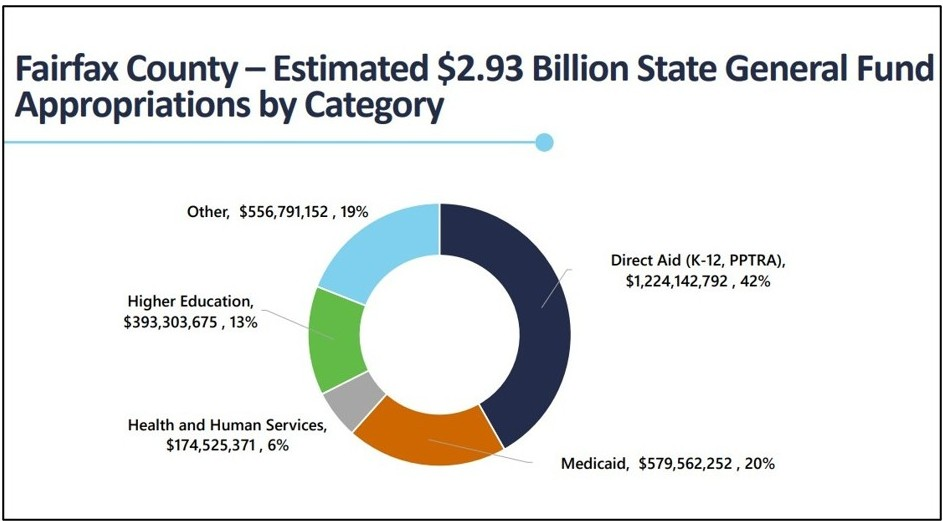
- Total state general fund appropriations benefiting Fairfax County amounted to $2.93 billion. That’s just 11.1 percent of statewide general fund spending. That includes direct aid (such as funds for K-12 schools and personal property tax relief) and indirect aid (such as Medicaid, public health, social services, and higher education).
- Among the 133 localities in Virginia, Fairfax County ranks 128th in the amount of state aid received. Lee County gets back the most revenue from the state – 426.6 percent of the amount it sends to Richmond. Radford County comes in second, and King and Queen County is third.
- Four of the five jurisdictions that receive less than Fairfax County are in Northern Virginia – Alexandria, Arlington, Falls Church, and the City of Fairfax.
- Fairfax County contributes one-fifth (20.7 percent) of all state revenue. That’s more than the next three largest contributors combined. Loudoun County, in second place, contributes just 7.5 percent of state revenue.
- Fairfax County Public Schools, the largest school district in Virginia, serves almost 15 percent of the state’s K-12 students. Yet it receives just 10 percent of the state’s K-12 dollars, based on the Local Composite Index. The LCI is mostly based on a locality’s value of real property, residents’ incomes, and taxable retail sales.
At the committee meeting, Board of Supervisors Chair Jeffrey McKay suggested Northern Virginia jurisdictions should band together to push for structural change.
The budget situation should be considered in a broader context, McKay said: “While the state had a $1 billion surplus this year, the budget for the coming years is uncertain due to the absolute destabilizing chaos that’s occurring in Washington, D.C.”
Fifty cents on the dollar is a better return from the state than what taxpayers get from the county. Then again, how can you assign a dollar value to a colorful infographic declaring that the county’s governing doctrine, One Fairfax, will proudly embed an “Equity Lens” into every decision?
This doctrine is presented as magic, overlooked since the dawn of civilization, yet now deemed critical to our future success. I struggle to understand how civilizations like Babylon and Rome, so advanced in law and infrastructure, failed to include such a lens in their foundational doctrines. Hammurabi etched 282 laws in stone, but somehow forgot to commission a racial equity impact assessment. Rome codified property rights and civil procedure, but never convened a cross-sector equity task force. Even the U.S. Constitution, with its checks and balances, omitted a color-coded infographic pointing to “systemic barriers.”
The oversight is breathtaking.
Meanwhile, the quality of life for residents of Annandale continues to deteriorate. Rising crime, creeping blight, failing services, and an insatiable appetite for new revenue now demand that multiple-family construction be built on every single-family home that can be demolished.
In the end, Annandale and the county doesn’t need another doctrine, it needs leaders who remember that equity begins with safety, service, and stewardship.
I love your posts. Please continue!
My two cents on this is that I’ve reviewed a lot of budgets in my day. The pie chart or line graph or top line whatever means nothing to me. Show me what rolls up to that. Companies or governments that won’t show the roll-up are hiding what’s buried in there. If someone wanted to make a lot of money, they could lobby with an AI company as a sub and an audit company as a prime to scrape what rolls up into these ridiculous dashboards.
Fairfax getting back 50 cents on the dollar is due to the state’s funding formula, which redistributes revenue based on infrastructure load, school enrollment, Medicaid needs, higher-education funding, and statewide service obligations.
Here’s what the chart is telling us:
42% of Fairfax’s returned money is tied up in K–12 direct aid, a statewide formula that primarily benefits counties with lower property values and smaller tax bases, not “red areas.”
20% goes to Medicaid, again based on population need, not political color.
Higher ed, HHS, and “Other” categories are statewide systems, Richmond doesn’t tailor those based on voting patterns.
In other words, Fairfax isn’t subsidizing “red areas”; it’s subsidizing the structure of the state, schools, Medicaid, public universities, and shared services used by everyone.
I will have to check out the Local Composite Index. Given the high value of real estate and the county’s real estate tax rates, I suspect that this could complicate the formula thus reducing what the state provides back to Fairfax & allowing for a baseline funding across the state (which would make up for lower real estate values & tax revenue elsewhere). That is not uncommon in government. Thus the rest of the state would point out that Fairfax is still taxing and spending more than other counties on the schools while getting the same amount for a baseline. Those other counties don’t have the same costs or capacity (tax base) to raise taxes upwards (constantly) like Fairfax. Well, until Fairfax realizes that living on the Federal government teat is being severely depressed / reduced. Forcing Fairfax to make real and hard governance decisions. If not today then in the very near future. Lord help us all as it seems to be beyond the current Board of Supervisors capacity to handle.
Good to see a comment built on economics instead of the tired tropes and blanket stereotypes that too often substitute for serious thought here.
So 50cents of every dollar is going to the other red parts of Virginia that are mostly racist and close minded , so I have to work to support them being a racist. Why is this to common the blue areas and blue states sending money to the federal government to send to red states that mostly do not care about equality or love there neighbor as their own ect ect u know the rest . I am sure somebody will twist my words and make it seem they are doing me a favor but these facts seem to be all over the map in all
The states .
According to our latest armchair economist, half of every dollar in Virginia is siphoned off to fund “mostly racist and close‑minded” red counties. Picture it: Richmond accountants hunched over voting maps, stamping checks with red ink that reads “Congratulations on your prejudice, here’s your subsidy!”
Of course, reality is far less cinematic. Funding formulas don’t ask how you voted; they ask how many lane‑miles you maintain, how many kids are enrolled in your schools, how old your infrastructure is, and how much poverty you’re fighting. Rural areas get more per capita because it costs more to keep the lights on when your tax base is smaller and your geography is bigger. That’s arithmetic, not ideology.
But why let math ruin a good morality play? It’s so much easier to declare entire regions “racist and close‑minded” and then bask in the glow of your own virtue. Never mind that you’ve just stereotyped millions of strangers you’ve never met, apparently prejudice is acceptable if it points in the politically convenient direction.
If you want to debate tax flows, bring data. If you want to write partisan fan fiction, at least admit it’s fiction. The heroic tale of blue areas nobly “funding” red areas because the latter are morally defective isn’t economics, it’s mythology complete with villains, saints, and a plot twist so bad even Netflix would pass.
…”bask in the glow of your own virtue.” Gotta remember that description – so true for the majority-voting FFX populace…it’s why One Fairfax can live on and on as a wonderful younger sibling to California’s “virtue” themes.