
The Dominion/NextEra merger called a ‘bad deal’ for Virginians

The proposed merger of Dominion Energy and NextEra Energy is a bad deal for Virginians, as it will likely lead to higher electric bills for residents and businesses.
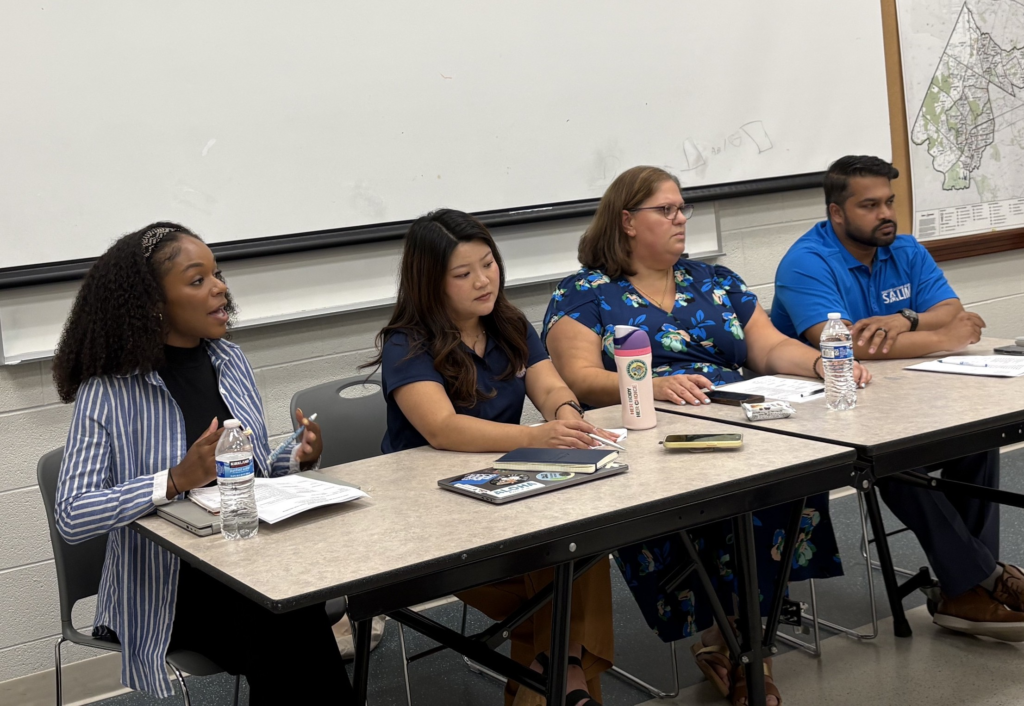
That’s the consensus of the panelists who spoke at a community forum on Aug. 30 at the Sully Government Center in Chantilly.
NextEra, a Florida-based energy company, is proposing to acquire Dominion in an all-stock deal worth approximately $67 billion.
Contact the SCC
The merger – actually NextEra’s purchase of Dominion – must be approved by Virginia’s State Corporation Commission and federal regulators before it can take effect.
Members of the General Assembly from Northern Virginia and a coalition of consumer groups are calling on residents to urge the SCC commissioners to deny the merger.
The SCC is holding public hearings on the proposal (case no. PUR-2026-00112) on Nov. 5, 9, and 10. The last day to register as a witness is Nov. 2. Comments can be submitted here.
“Bombard the commissioners and legislators,” said Sen. Stella Pekarsky (D-36th District). “They need to see the breadth of concern from constituents.”
Related story: Dominion sale raises alarm bells
“If the merger is approved, it would combine Dominion’s Virginia customers with NextEra’s operations across Florida and the Carolinas, creating one of the largest regulated mega-monopolies in the world,” said Kajsa Foskey, director of the Virginia Consumer Energy Alliance.
“This will be historic; that’s enough to hit pause,” Foskey said. There’s also no requirement that the combined company has to honor the Virginia Clean Economy Act, which is a binding commitment to prioritize alternative energy.
Rising electric bills
Dominion customers have been seeing annual rate hikes for years. One factor is Dominion’s struggle to keep up with demand from the fast-growing data center industry.
According to Dominion, the combined company will not result in higher costs for consumers, but critics aren’t buying it.
NextEra’s Florida utility company just received the largest rate hike in U.S. history, worth $7 billion, Foskey said. “There’s nothing in this deal that guarantees Virginia won’t be next.”
As a condition of the merger, Dominion says customers will get bill credits equal to about $10 per month over the next two years, but there’s no information on what happens after that.
Meanwhile, Dominion’s shareholders will get $360 million in cash the day the deal closes, Foskey said.
If the merger is approved, Del. Irene Shin (D-8th District) said Dominion will be able to guarantee a rate of return for stockholders, as utilities are seen as a profitable industry with a captive market.
“We need to hold the SCC commissioners accountable so ratepayers are not bearing the cost for data centers,” Pekarsky said.
Utility costs for schools and government buildings have gone up 25 percent, while schools are experiencing frequent power outages.
Delay urged
Sen. Saddam Azlan Salim (D-37th District) criticized the short timeline for getting the merger approved.
The plan was announced in May after the end of the General Assembly session, and a joint filing was submitted to the SCC on July 15. “They want to get it approved before the next session,” he said.
Gov. Abigail Spanberger took the unusual step of formally intervening in the merger case. That will give her “the legal right to engage, bring concerns forward, request detailed information about the proposed merger, and make clear that Virginians expect to see long-term, tangible benefits of any potential deal.”
“As Governor, I remain skeptical of the benefits this merger would deliver to Virginia – particularly if those benefits come at the expense of affordability, existing jobs, or meeting our homegrown clean energy goals,” Spanberger said.
Fairfax County, the City of Alexandria, Virginia Attorney General Jay Jones, other local jurisdictions, and environmental organizations have also filed to intervene in the case.
A corrupt company
Opponents of the merger point to NextEra’s history of shady business practices.
This June, Foskey noted, NextEra agreed to a $150 million settlement to resolve a federal securities lawsuit over its involvement in a Florida political corruption scheme.
The allegations included bribery, off-the-books recordkeeping, surveillance of a journalist, and the use of a “ghost candidate” to defeat legislators who opposed the utility’s policies.
NextEra has disconnected more homes for nonpayment than nearly every other power company in America, Foskey said.
While NextEra said it would retain jobs in Virginia for 18 months, Shin said, there’s no guarantee on what happens after that.
Residents at the forum raised concerns about a conflict of interest due to SCC Chair Kelsey Bagot’s past job as a senior attorney at NextEra.
“Challenging Bagot is not the way to go,” Shin said. “She has real expertise. I trust her to interpret the law for the best interests of Virginians.”
Bagot sought outside counsel who told her she is not violating any law or ethical principles by hearing the case. There are just three SCC commissions, and both Shin and Salim said they would rather have three people looking at this case than two.
Legislative action
The General Assembly can pass legislation in the next session to prevent this kind of merger, but it won’t be retroactive.
“Only regulators can stop this,” Salim said.
Pekarsky said she supports a special session of the General Assembly to delay the SCC decision and change the timeline. However, Shin countered, “It would be extraordinary to have the timeline changed while the process is already going on.”
“The political influence is a very big part of what worries me,” Pekarsky said. Campaign finance reform legislation “to curb corporate or Dominion contributions has been introduced repeatedly, but always dies in committee year after year.”
Related story: Viewpoint – Virginia’s powerful problem
Shin noted that in the past, NextEra unsuccessfully attempted to merge with utility companies in South Carolina and Texas. Texas determined the merger was not in the best interest of ratepayers, she said. Virginia has broader standards.
At a virtual meeting last week hosted by Salim, Bill Murray, the senior vice president for corporate affairs and communications at Dominion, declined to comment on the long-term impact on utility rates.
He said Dominion will benefit by having access to cheaper credit and the opportunity to buy energy more efficiently.
Shareholder vote
Dominion shareholders are scheduled to vote on the merger on Sept. 3. Freeda Cathcart, a shareholder who opposes the merger, wrote in an email that there is concern that the Dominion board and executives aren’t fulfilling the fiduciary duties that require them to put the corporation’s interests before their own personal interests.
Many Virginia residents might not know they are invested in Dominion through their 401(k)s, IRAs, or pension plans, Cathcart said. She urges people to find out if they are shareholders and eligible to vote.
She noted that Dominion CEO Robert Blue stands to receive a compensation package of over $30 million if the deal goes through.
“It appears that the Dominion executives and board haven’t been forthcoming to shareholders and are rushing the decision to vote on the merger,” she said. “The way the merger was rolled out and the rush to get it completed is reminiscent of a scam where con artists try to confuse and rush their mark into falling into their trap.”
This issue has the Govenor’s attention. She is opposed to the merger and is working to prevent it going through.