
Viewpoint: Virginia’s powerful problem
By Paul Gilbert
Data centers, global climate change, the merger of power companies, and corporate money in politics seem like different issues, but they are all connected – in some ways literally, through power lines, and in other ways through cause and effect.
Let’s “think globally, and act locally.” Climate change is driven by too much carbon in the atmosphere, and that pollution is accelerating because of the giant energy needs of the AI revolution and the fast expansion of data centers.
Related story: Dominion sale raises alarm bells
Because Northern Virginia is the center of the data center boom, Virginia is the second largest importer of electric power behind California. This oversized energy consumption, and the higher rates that you and I are paying, is exactly why NextEra Energy is trying to buy Dominion Energy.
Local governments need the tools to address data centers, and those tools have to come from Richmond. Virginia is a Dillon Rule state, meaning local governments have only the powers the General Assembly gives them.

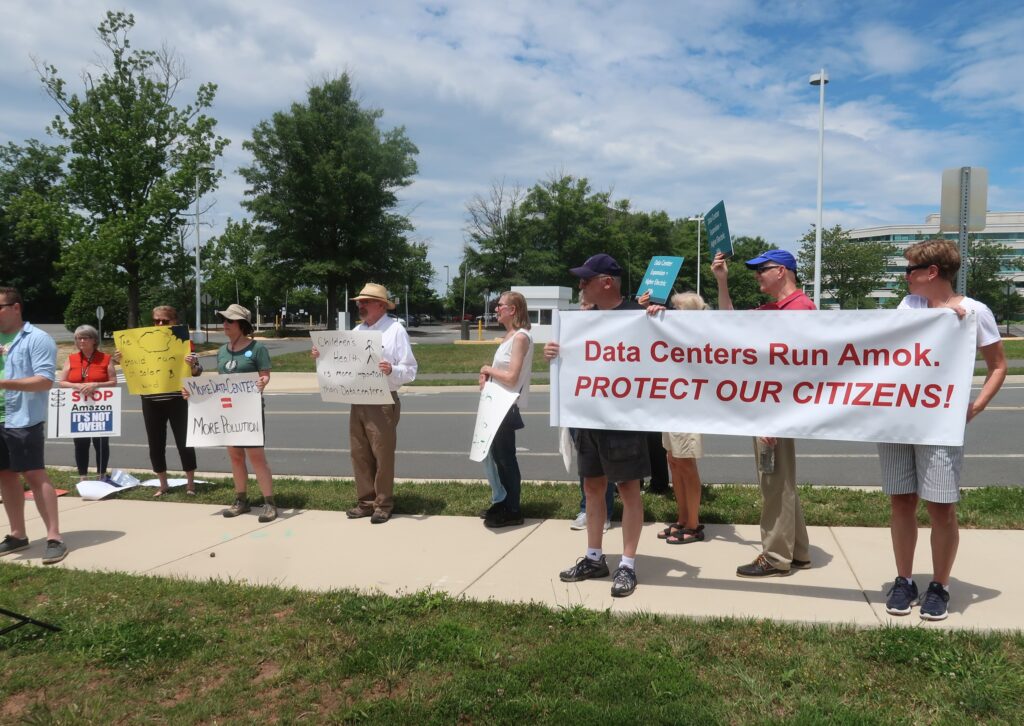
Look at the data center proposed for Edsall Road inside the Beltway in Fairfax County: Nobody wants it there, but local officials can only weigh in on the land use issues related to the electrical substation, not the actual data center.
In 2025, a bipartisan bill that would have let localities consider impacts on water, power infrastructure, and nearby neighborhoods passed the General Assembly, only to be vetoed by Gov. Glenn Youngkin.
Let’s give decision-makers the tools they need to do their jobs. While it’s marketed as a “merger,” NextEra is buying Dominion Energy. NextEra is offering some short-term benefits, but what it’s really buying is the energy consumption of Virginia.
We already have a serious problem with Dominion, which is supposed to be a regulated monopoly. Between 2013 and 2023, Dominion spent over $25 million on political contributions.
Today, Kelsey Bagot, a former NextEra Energy attorney, chairs Virginia’s State Corporation Commission, which has the responsibility to approve or reject the proposed “merger.”
In 2024, the General Assembly elected Bagot as a commissioner. How does a conflict of interest this obvious happen? Corporate political contributions are a big part of the answer. An even larger, and more powerful monopoly is not the answer to long-term affordability for ratepayers.
Related story: Community members speak out against a substation at Plaza 500
These related problems are not easy, but they are all solvable:
(1) While the governor, lieutenant governor, and some members of the General Assembly are asking for more time to study the NextEra-Dominion merger, what we really need is for them to say No. You and I are already paying more for energy. Clearly, NextEra is hoping the Virginia electric market will become even more profitable.
(2) Hawaii and Montana have taken legislative steps this year to get corporate money out of politics by changing the powers the state grants to corporations. Eliminating corporate political giving will strengthen our democracy and reduce these conflicts of interest. The Virginia General Assembly should act on this right away.
(3) Local governments need more tools to make thoughtful decisions related to data centers. The General Assembly should empower localities to consider power, water, and associated infrastructure when they consider these applications. The General Assembly should grant local governments the powers they need.
(4) We need the Virginia Department of Environmental Quality or the federal EPA to establish regulations on the use of power and water by data centers. Our environmental regulations were written for a previous era; they need to be updated.
(5) To achieve ecological balance, some of the revenue data centers generate should fund the protection and expansion of natural areas. Trees are our best carbon-capture machines. Photosynthesis works! Expanded parks and natural areas will absorb carbon from the air and recharge the aquifers we depend on for fresh water. This is how we can achieve real sustainability.
The AI revolution and the resulting explosion of data centers have caught policymakers unprepared. The five steps above would solve Virginia’s powerful problem, and in the process, strengthen our democracy, improve affordability, and address climate change. These are all doable solutions that need action.
Paul Gilbert was recently appointed by Gov. Abigail Spanberger to the Board of Conservation and Recreation. He is executive in residence for the Recreation Management Program at George Mason University and was the executive director of NOVA Parks from 2005 to 2025.
Thank you for this thoughtful, informed commentary.
I couldn’t agree more with Mr. Gilbert. Thank you so much for an excellent summary of the issues that Virginia (and the rest of the country) needs to address ASAP.
The problem is we import energy. We need more coal, natural gas, hydro, and nuclear power stations in VA. That is an issue the government can fix by cutting the state regulatory environment.
Mark, we need Dominion to approve more Solar Power and Battery bank development. We do not need an additional fossil-fuel driven power plant in VA.
Incentivize home solar panel installation and reduce the approval delays imposed by Dominion.
If NexEra buys Dominion Energy, will Virginia stop importing Energy from (other countries?). How much is NexEra paying for Dominion Energy?
I think that FCPS and Dominion each need to provide their own assessments of why a large number of schools had power issues the day before school started. I saw the FCPS superintendent on the news speaking about it briefly. If the suggestion that the power usage from all the data centers is a leading factor, then the counties and the state need to figure out how the home consumers and small businesses are going to be protected from rising rates and increasingly poor service. I look at the outages from the storm two nights ago that are still being addressed today, as a lack of resources for restoration, and perhaps a lack of resources applied to proactive actions such as limb/tree removal before storms and burying power transmission or routing transmission lines around areas that have had extreme tree/limb cause issues.
I don’t see NextEra doing anything positive for our experience, especially given the big rate hike they hit Florida customers after their FP&L acquisition.