
Health & Wellness: You’re being sold a better life – thousands of times a day
By Rachel Martin
The average person is exposed to somewhere between 4,000 and 10,000 advertisements every single day.
At first, that number sounds ridiculous. But when you factor in social media, TV, podcasts, emails, billboards – it adds up quickly. And here’s the important part:
The best ads don’t just sell products. They tap into how your brain is wired.
In The Scarcity Brain, Michael Easter explains something called the scarcity loop – the idea that, as humans, we are constantly scanning for what we might be lacking. Thousands of years ago, that instinct kept us alive. If we didn’t find enough food or stay alert to danger, we didn’t make it.
Today, that same wiring is being used in a different way.
Advertisements quietly suggest:
- You’re missing something.
- Your life could be better.
- This product will help.
And if you’re honest, it works.
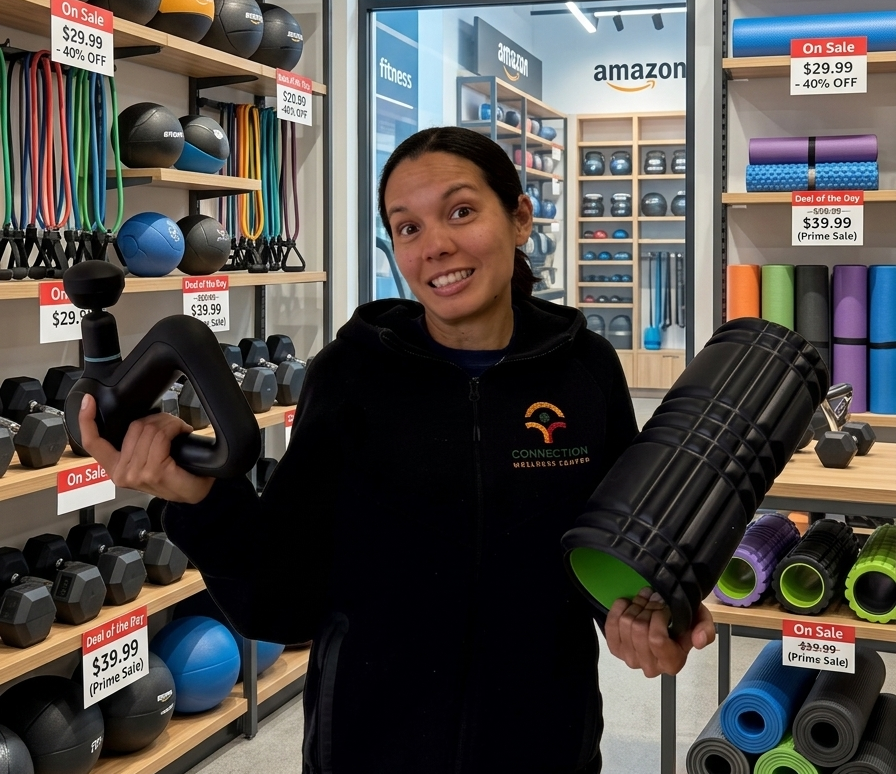
I know it works on me. Just ask my girlfriend about the things I’ve bought in the name of “health,” such as cleaner water systems, nontoxic cleaning supplies, and higher-quality food for our dog. None of those things are bad.
But at some point, I had to ask myself: Am I focusing on what actually matters – or just reacting to what I’m being sold?
When trends replace the truth
Let’s bring this into fitness.
We live in a world of data. Step trackers. Sleep scores. Recovery metrics. You probably have a Fitbit or Apple Watch, or know someone who does.
And there’s real value in that.
Tracking movement can help you move more. Tracking sleep can help you prioritize recovery. And those things matter, because the data is clear:
- Chronic sleep deprivation is linked to a 48 percent higher risk of heart disease.
- It’s associated with a 3x higher risk of type 2 diabetes.
- It impacts your brain’s ability to clear toxins, increasing the risk of neurodegenerative diseases like Alzheimer’s.
That’s real. That’s important.
But here’s where things start to drift.
When you’re exposed to thousands of messages a day telling you to optimize this, track that, add this routine, buy this supplement, it’s easy to feel like you’re constantly behind.
You feel like you’re not doing enough, and your health depends on getting everything just right.
And that’s where people get lost.
The real problem: We’ve lost the definition of fitness
Part of the reason I started writing these articles was to push back on that feeling.
That’s because you don’t need a perfect morning routine, 12 supplements, and a cold plunge before 9 a.m. to be healthy.
What you do need is clarity. And that starts with understanding what fitness actually is: Not the trendy version and not the marketed version – but the real, measurable, trainable definition.
Related story: Health & Wellness – Manage your health with a DEXA scan
One of the most complete ways to define fitness comes from CrossFit, the fitness organization that specializes is functional fitness, which breaks it down into 10 key skills:
- Cardiovascular/respiratory endurance – how well your body uses oxygen.
- Stamina – your ability to sustain energy over time.
- Strength – your ability to produce force.
- Flexibility – your range of motion.
- Power – force applied quickly.
- Speed – how fast you can move.
- Coordination – how well your body works together.
- Agility – how quickly you can change direction.
- Balance – your ability to control your body.
- Accuracy – your ability to control movement precisely.
This definition changes everything
As a gym owner for over a decade, here’s what I’ve consistently seen:
Most people are strong in one or two of these areas – and completely neglect the rest.
- Someone who walks three times a week has endurance, but may lack strength
- Someone who does yoga has flexibility, but may lack power
- Someone who plays pickleball or tennis has coordination, but may lack balance or resilience.
And again, none of that is bad.
But if your goal is longevity – if you want to keep doing the things you love not just now, but 10, 20, 30 years from now – then it’s not enough to rely on one area of fitness.
Because life doesn’t demand just one skill.
It asks you to:
- Get up and down off the floor.
- Carry heavy groceries.
- Catch yourself when you trip.
- Move quickly when it matters.
- Stay strong as your body changes.
That’s what real fitness prepares you for.
It’s not a trend and not a metric. It’s a complete system.
And that’s the difference.
If this resonates with you, the next step isn’t to go buy another device or overhaul your entire routine overnight.
It’s to start understanding where you currently stand – and where you can grow.
Next Wednesday, April 29, at 6 p.m., we’re hosting a special presentation at the Connection Wellness Center in Annandale with physical therapist Dr. Rich Ortiz from MovementX on “How to Stay Strong, Build Resilience, and Stay Active for the Long Game.” And you guessed it – He will be covering those 10 pillars of fitness in much more detail.
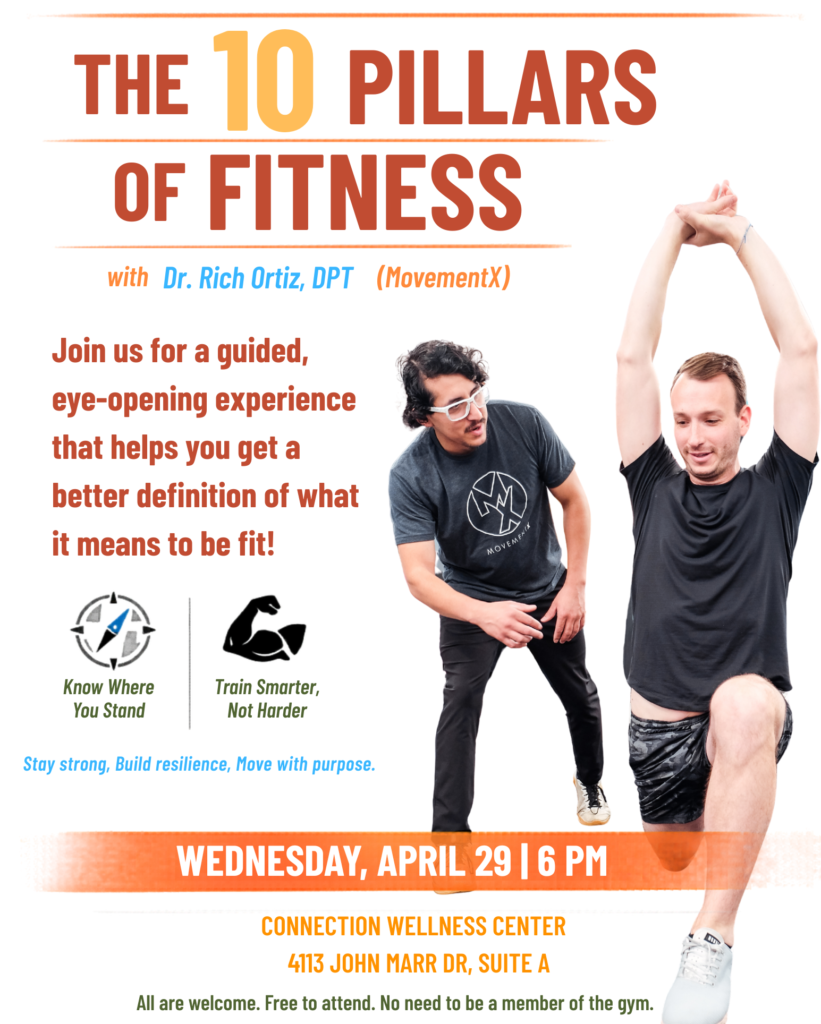
This session is for anyone who wants a clearer, smarter approach to taking care of their body, without getting lost in the noise.
And if you’re someone who wants to take it a step further, come to the Stronger Together event on May 16 at the Annandale Fire Department, which is designed to give you exactly that clarity.
It’s not a test, not a judgment.
This event offers a guided, eye-opening experience that will help you:
- See where you are across the key areas of fitness.
- Connect the dots between what you’re doing and what actually matters.
- Walk away with a clearer blueprint for what to focus on next.
It’s supportive. It’s approachable. And for many people, it will be the moment things finally start to click.
Because the goal isn’t to chase every trend.
It’s to build a body – and a life – that lets you keep doing what you love. Not only now, but down the line.
Rachel Martin, a certified personal trainer and life coach, is the owner of the Connection Wellness Center at 4113 John Marr Drive in Annandale.
Good stuff!
Thank you! Glad it resonates.
Rachel you are a great writer, this article is so good, it draws you in and you want to keep on reading and when you do that you learn so much !! Bravo woman, you rock !!
Thank you Tracy!! I really appreciate that. And happy to hear you’ve found it helpful!