
State leaders announce a compromise on a retail weed market
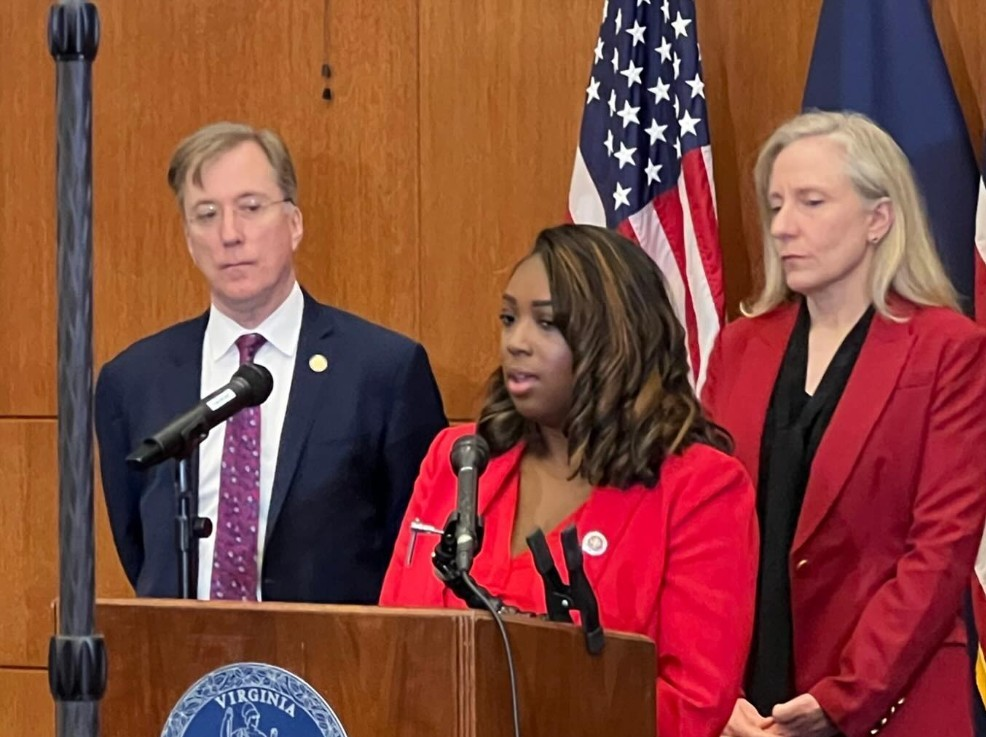
Virginia Gov. Abigail Spanberger and General Assembly leaders approved an agreement to establish a cannabis retail market that would open on July 1, 2027.
The compromise would be implemented through the budget process. It comes after Spanberger vetoed legislation passed by the General Assembly that would have allowed sales to start on Jan. 1, 2027.
The agreement worked out with Del. Paul Krizek (D-Fairfax) and Sen. Lashrecse Aird (D-Henrico) “will create a safe, legal, and well-regulated cannabis marketplace,” Spanberger said. “We will do it in a way that protects consumers, targets the illicit market with clear enforcement and regulatory authority, and creates a more competitive market for small businesses and farmers.”
Delaying retail sales until July 1, 2027, will give the Cannabis Control Authority (CCA) “sufficient time to develop regulations, establish testing and safety standards, and build the necessary oversight framework to ensure the marketplace launches safely and responsibly,” Spanberger said.
Related story: Spanberger vetoes retail cannabis market
“For too long, the failed war on drugs imposed real consequences on individuals, families, and communities, while doing little to create lasting public safety,” Krizek said. “This compromise restores important support for small businesses, protects impact licensees from predatory investment, and gives microbusinesses a real opportunity to succeed.”
Key components of the compromise legislation include the following:
- The measure would create a maximum of 350 retail cannabis establishment licenses statewide. That’s the number in the bill vetoed by Spanberger; she proposed a limit of 200.
- The CCA would begin accepting applications for licenses on Feb. 1, 2027. The 350 licenses would be approved on a phased-in basis, which Aird said would give the retail market “a real opportunity to meet demand across Virginia.”
- Customers would be able to buy up to 2 ounces of marijuana per transaction.
- The possession limit would be increased from 1 ounce to 2 ounces. The measure includes a $250 fine for public consumption, which is an increase from the current law, but Spanberger had initially proposed a Class 4 misdemeanor.
- The CCA would be authorized to set escalating penalties for retailers that fail to do ID checks, including license revocation for repeated underage sales and requirements that retail stores be at least 1,000 feet from schools, hospitals, playgrounds, and drug treatment facilities.
- Cannabis products would be subject to a 6 percent sales tax, increasing to 8 percent after July 1, 2029. Localities would also be able to adopt an additional 1 to 3.5 percent local tax.
- The revenue from cannabis sales would go toward early childhood education, childcare, K-12 education, behavioral health programming for substance use disorder prevention and treatment programs, public health programs, and the Cannabis Equity Reinvestment Fund.
- Several provisions address child safety, including prohibitions on cartoon advertisements, requirements for child-safe packaging, and prohibitions on products sold in the shape of animals, fruits, vehicles, or humans.
A retail cannabis marketplace has been under discussion in Virginia for at least 10 years. Legislation cleared the General Assembly twice but was vetoed by then-Gov. Glenn Youngkin.
After the General Assembly passed legislation in March creating a framework for a retail cannabis market, Spanberger returned it with dozens of amendments. State leaders opposed most of the changes and sent it back, prompting the governor to veto it.
The cannabis compromise is now tied to the budget process, which is at a stalemate due to a conflict over the sales tax exemption for data centers.
Related story: General Assembly to consider comprehensive study on data centers
The failed war on drugs has nothing to do with the proposed Virginia pot market.This excuse has been used for years .If you legalize drugs and use it in a supposed controlled ,regulated arena. The illegal drug market will decrease
.What a lie..Look at California as an example..Failed.More drug overdoses,abuse..Poor souls addicted to dope..The Cannabis authority.A lottery of 350 licenses is a sham..They say that this will go to schools,social justice programs ..Won’t happen..The Virginia gov is in the liquor business for a greedy profit Same with proposed cannabis..Funding schools with liquor and drug money is a terrible representation of government in action..The publicized version .Do a study .Set up a governing authority.Create regulations ..So citizens will believe it is legitimate..Alcohol,,car accidents are at an all time high ..It will be no different with pot..Ban Virginia from being in the drug and alcohol business..It does nothing for Virginias citizens .Just creates misery and heartache..
I agree. Let’s ban alcohol and see how well that does.
This state is turning to crap
Establishing retail marijuana outlets is a positive approach toward diversifying Virginia’s and Fairfax County’s sources of revenue, but more needs to be done to reduce Fairfax County’s reliance on property taxes.
The opposition to a casino in Fairfax needs to be overcome to ensure new sources of employment and revenue for Fairfax County and Virginia.
Furthermore, the time has come to legalize and regulate sex work to ensure the safety of sex workers, while establishing an appropriate level of taxation.
These options give Fairfax alternatives to being overrun by data centers (that do not require many workers once they are operating) and to ensure the funding needed to provide an excellent pre-K through college education to every child living in Virginia.
…. the level of ignorance is rising on this site.
Good news. About time.
How did this become a priority? When can we look to the light and good vs exploiting our worst human qualities?
You’d probably be less uptight if you smoked a bowl every now and then.
I must be missing something. It appears sale of pot will be taxed at a lower rate than lunch at McDonald’s in Fairfax County. We were told pot taxes would be a major revenue source. We can save money by having some pot instead of a meal?
Pot is not as harmful as McDonald’. That supersize me guy died recently.
I’ll just go to Maryland until Virginia catches up with the real world.