
Residents raise concerns about streamlining ALU rules
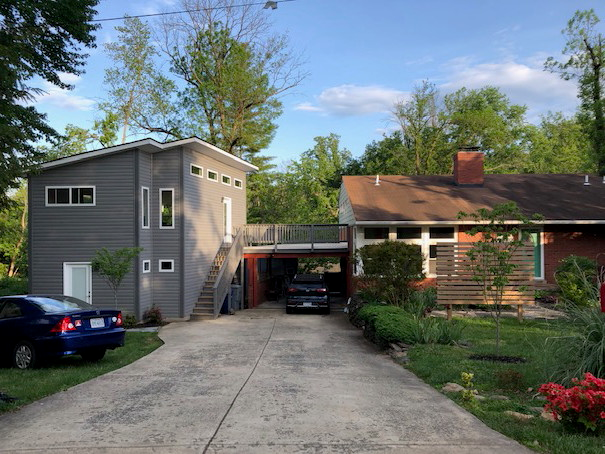
Residents are concerned that new, more lenient rules on accessory living units (ALUs) would lead to more rental properties and less parking in stable single-family neighborhoods.
Zoning official Carmen Bishop and her colleagues in the Department of Planning and Zoning described a proposal to make it easier to establish ALUs at a community meeting on April 23.
An ALU is a separate living space – with facilities for cooking and sanitation – inside a primary dwelling unit or in a detached structure on a homeowner’s property. ALUs are often occupied by elderly parents, an adult child, an au pair, or tenants.
Under the current zoning ordinance established five years ago, interior ALUs that meet all standards only need an administrative permit. Detached ALUs must be on lots of two or more acres and require a special permit, which means there must be a public hearing.
Permits must be renewed two years after approval and then, every five years.
Related story: Rule changes would make it easier to establish an ALU
ALUs are restricted to two occupants and two bedrooms. Interior ALUs can’t be larger than 800 square feet or 40 percent of the primary building. Detached ALUs are limited to 1,200 square feet.
New rules proposed by the department would make it easier for homeowners to establish ALUs by eliminating some of the administrative barriers and streamlining the review process. That is being done, Bishop said, because too few homeowners have applied for ALUs or gotten their permits approved.
Between July 1, 2021, and Oct. 31, 2025, only 158 of the 407 ALU permit applications were approved. Another 69 ALUs that had been approved weren’t renewed after the two-year permit period expired.
More flexibility
Some of the rule changes under consideration would:
- Allow an administrative process for detached ALUs.
- Allow detached ALUs on lots smaller than two acres.
- Allow interior ALUs to be up to 50 percent of the size of the principal dwelling.
- Allow more flexibility in the definitions of interior and detached ALUs.
- Eliminate the requirement for permit renewal.
- Review an application for an interior ALU as part of the building permit application, and drop the requirement for a separate administrative application.
- Eliminate the requirement for an additional parking space.
Bishop said zoning officials plan to submit draft text on a revised ALU ordinance to Board of Supervisors and Planning Commission committees this summer. Public hearings would be held in the fall.
Concerns
During the community meeting, several people raised concerns about how the ALU rules are enforced.
If there’s a suspected violation, it could be reported to the Department of Code Compliance, which would conduct an investigation, Bishop said. If the violation is not addressed, the case would be referred to the county attorney.
There are many ALUs throughout the county that are not registered as such, someone else noted, and Code Compliance doesn’t have enough staff to adequately carry out inspections.
Someone else worried that investors would buy up single-family homes and establish ALUs that would be converted to short-term rentals, like Airbnb, which would destroy the character of neighborhoods.
Bishop noted that short-term rentals are not allowed on a property with an ALU.
There were several questions about the possibility of allowing ALUs in communities with homeowner associations. Bishop confirmed that HOA rules do not override the zoning ordinance.
Survey results
According to a survey conducted by Fairfax County this winter, 58 percent of respondents agreed that the county should explore zoning changes to expand opportunities for ALUs. Just over a third, 34 percent, disagreed, and 8 percent were unsure.
When asked to cite the most important benefits of ALUs, 68 percent cited flexibility in living options for families, 61 percent said aging in place, 36 percent said affordable rental opportunities, and 25 percent said ALUs would provide additional income for homeowners.
When it comes to survey respondents’ primary concerns, 53 percent said parking, 45 percent said impacts of additional construction, and 28 percent said traffic.
More than half (52 percent) of respondents said ALUs should not be allowed in townhouses, which is one of the changes under consideration.
In addition, 65 percent said the property owner should be required to live on the property, and 50 percent said an additional parking space should be required.
When asked whether a detached ALU should be allowed without a public hearing, 51 percent said yes and 44 percent said no.
A new state law
Legislation approved by the Virginia General Assembly (Senate Bill 531) this session and signed by the governor would require all localities to allow ALUs in single-family residential zoning districts.
It also limits the fee for ALU permits to $500 or less. Fairfax County charges $270 for an administrative permit and $585 for a special permit.
The bill prohibits localities from requiring setbacks for an ALU that are greater than the setback required for the primary dwelling. And it prohibits conditions for ALUs that are more restrictive than those for single-family dwellings within the same zoning area with regard to height, rear or side setbacks, lot size or coverage, and building frontage.
The bill won’t take effect until July 1, 2027, and won’t apply to a locality that adopted an ALU ordinance prior to Jan. 1, 2026. Fairfax County’s zoning ordinance has been on the books for years, so the new law won’t apply here.
One would be foolish to invest their life savings in a single family house in Fairfax County just to end up with a tool shed apartment on one side and a group home for recovering pedofiles on the other.
We already have single family houses in the Mason district that are functioning like group homes with no enforcement of zoning regulations. Now the county wants to legalize boarding houses.
Just great!
Fairfax county can’t control the number of adult residents living in a single family home, what makes them think they can limit the number of residents in an ALU.
Why is Fairfax County against single family neighborhoods? We work hard and save to live in a single family house and now the county wants to effectively do away with single family neighborhoods.
They currently don’t enforce occupancy codes in single family homes and now they are essentially going to legalize boarding houses.
Shame on them.
I’m all for relaxing the ALU laws, let us do what we want with our land! You want to alleviate the affordability crisis, well this is one way and it helps everyone.
Doing this will destroy neighborhoods. By helping the lowest common denominator, everyone else is brought down, just like housing values. Typical democrat thinking to lower standards and hurt everyone except the few losers who shouldn’t be in these neighborhoods in the first place.
Let’s see how much you like it when parties and wafting marijuana smoke bother your little kids playing in the backyard, and cars go 55 mph through a 25.
Single family neighborhoods are for people who can afford it and who treat it nicely because they value it. If you want to live in a city, move to a city.
How are cities doing?
Can’t believe I’m about to advocate in behalf of strict zoning regs, but here goes…
What attracts most homebuyers to suburban communities like Fairfax is the opposite of what you suggest–some control over land use to prevent and preempt helter skelter development that is unsightly and overtaxes infrastructure and services and makes the place look like Bangalore.
And it doesn’t help everyone as you say. That’s an old, oft repeated socialist lie-everybody wins. In fact, what happens is homeowner/investors lose property values which in turn begins the downward spiral to fewer purchasers and even lower values. In short, everybody loses.
IF this is going to be done, I think we taxpayers should demand all supervisors, zoning officials, and other county employee homeowners build an ALU on their property first!
I am not sure why the notions of ALU will reduce property value as long as the curb appeal is kept up.
This measure is merely the county’s stepping stone to eliminating single family zoning just as is being done in Arlington and Alexandria with “missing middle” housing. Soon, we will be facing duplexes-sixplexes in single family neighborhoods.
The proposed ADU rules further limit citizen involvement and participation, a disturbing trend in a county that prides itself on community engagement.
The 2 acre restriction never made much sense to me. An easy change would just be to do 1/2 and acre. This would alleviate the parking problem in neighborhoods that are mostly 1/4 acre or less. 1/2 acre to 1 acre properties are more able to accommodate. The lower middle to middle class neighborhoods would be crushed if this was allowed on 1/4 acre and below lots.
YOU PEOPLE voted for this….
Congratulations UI’s!!!
Not really sure how the pictured house meets the current ALU rules. Per Redfin, it was listed for sale on Apr 24 (https://www.redfin.com/VA/Falls-Church/3530-Slade-Run-Dr-22042/home/9636688). The listing shows the property size is a little over half an acre, but if the structure on the left isn’t technically “detached” per Ffx Co (despite the listing calling it a “separate guest house”), perhaps the 2-acre min size lot doesn’t apply.
I noted in the picture accompanying this article that a car is parked on the grass. Isn’t this illegal according to FxCo code? I am under the impression that cars in yard areas can be parked only on paved surfaces. If I am correct and I am not 100% certain that I am, right off the bat we see one problem with the ALU’s.